

Three generations of female psychiatrists show the power of role models and support
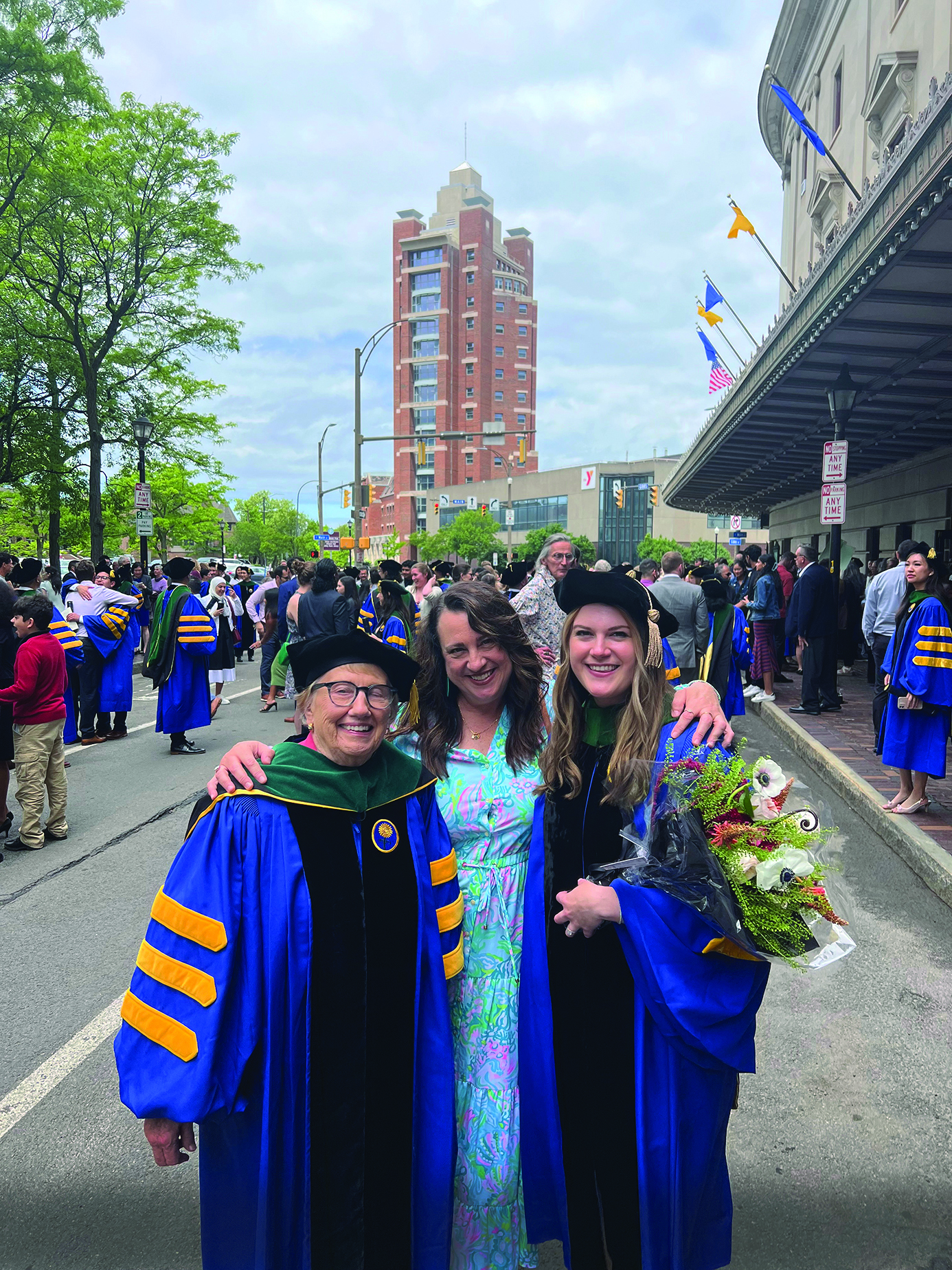
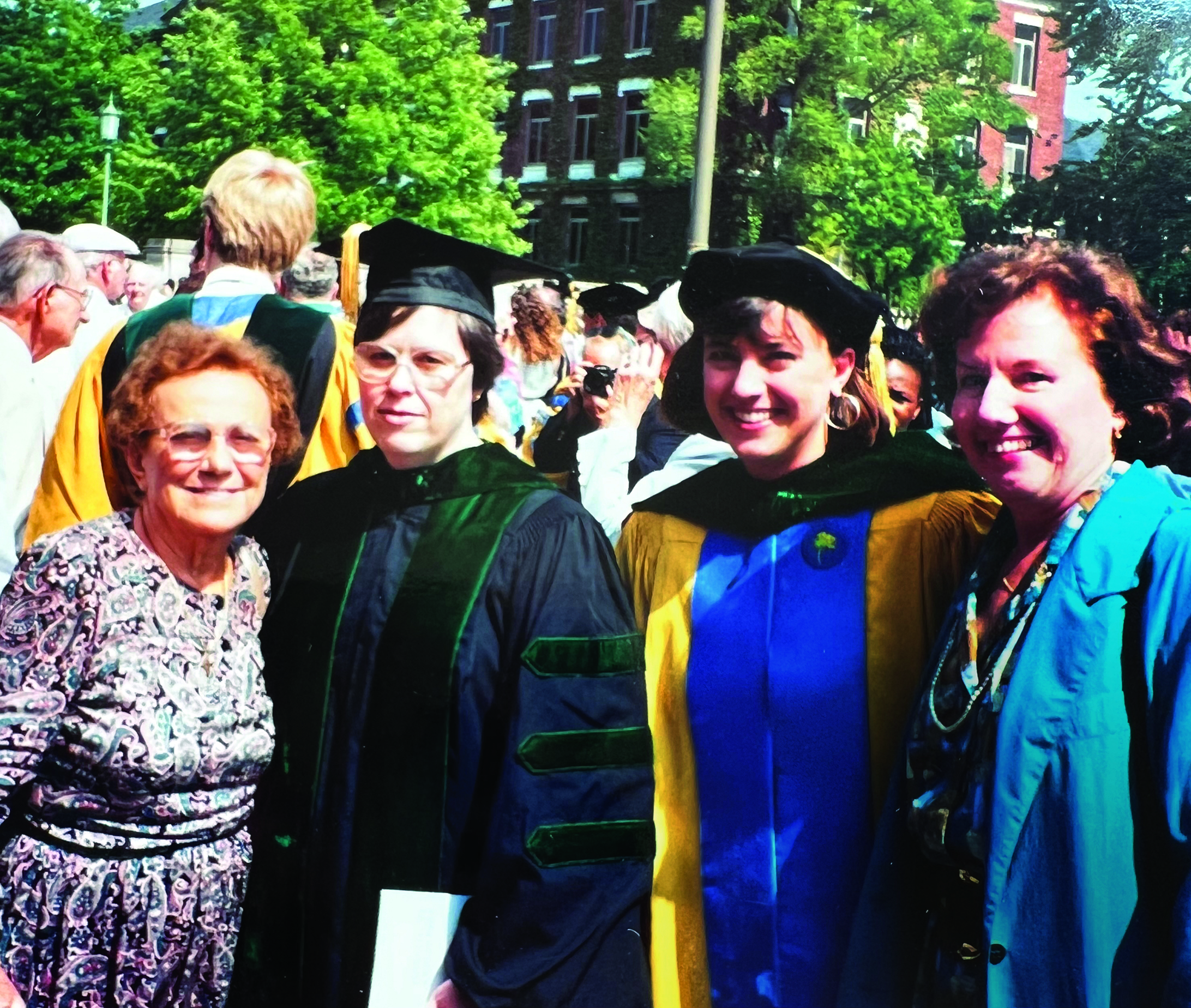
In May 2024, Anastasia “Tasia” Gibson stood in her blue graduation robe as she prepared to receive her medical school diploma from SMD. When her name was called, she crossed the stage to a familiar face waiting for her.
Her grandmother, Joyce Kales, also in blue, smiled as she reached up to lift the hood over her granddaughter before wrapping her in a hug.
Tasia (MD ’24) is on track to be the third-generation female psychiatrist in her family. Her mother, Helen Kales (MD ’92), chair of Psychiatry at UC Davis Health, followed in the footsteps of her mother, Joyce, who entered the field at a time when pursuing academics—or any full-time career for that matter—was uncommon for women with young families.
In the ceremonial hooding that day in Rochester, mothers and fathers took part but there were very few grandparents doing so. And definitely no grandmothers, Tasia recalls.
“It was a full-circle moment,” she said. “It felt like such an accomplishment and amalgamation of so many years of hard work from my whole family. Having my grandmother be the one to do it felt really incredible and special.”
Their special family story of accomplishment and perseverance began with trailblazers who didn’t set out to blaze trails.
Lives Intertwined
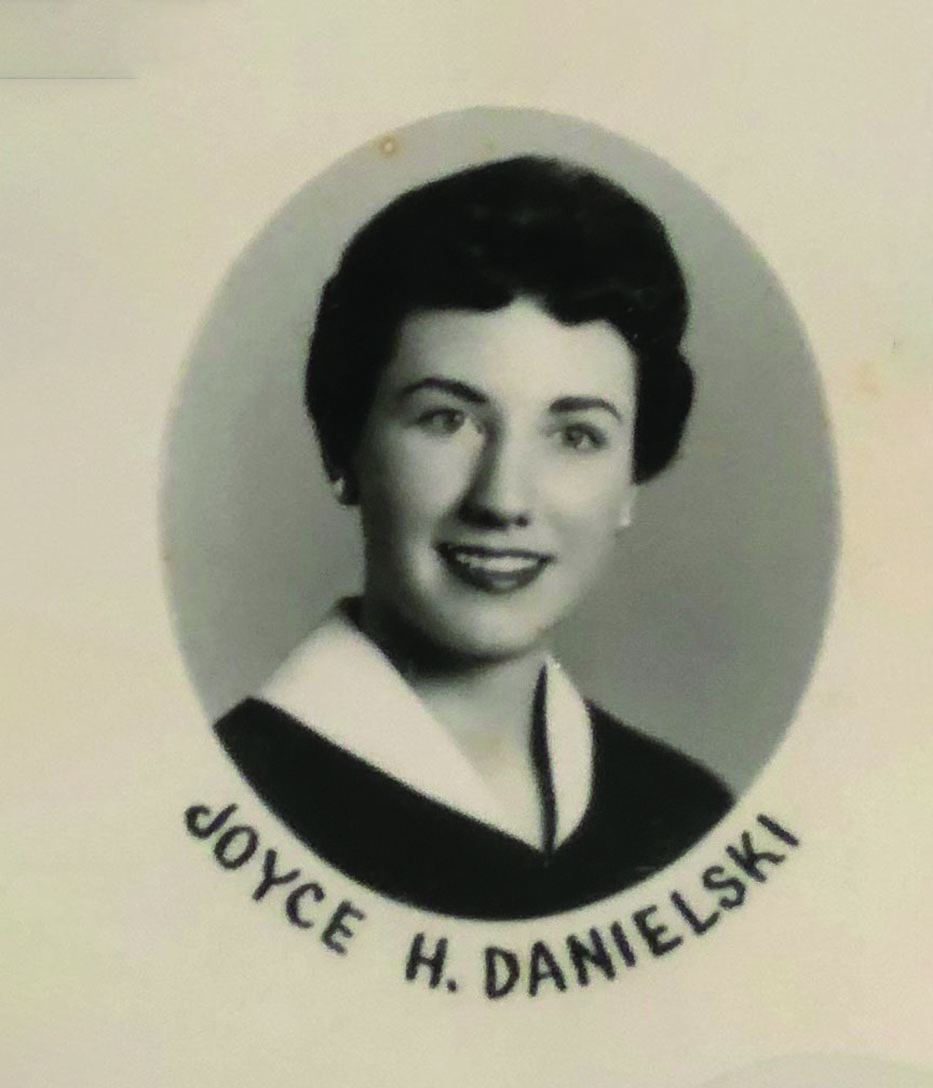
Joyce (then Danielski) came from Polish immigrants. Growing up in Detroit, where her father was a factory worker after World War II, she and her siblings saw higher education as a way forward. Joyce admired her older brother, who came home from medical school with fascinating stories.
In the early 1950s, Joyce attended Wayne State University in Detroit, unsure what to study but never thinking medicine was an option. One day, in biology class, she was partnered with a young man for a frog dissection. He brazenly insisted they finish the lab report at her house. Little did she know that first encounter with Anthony “Tony” Kales, the bright and magnetic son of Greek immigrants, would lead to intertwined lives and careers.
The two began dating. When Tony went off to medical school, he said she should do the same. “You really belong here,” he told her. Those simple words landed at the right time.
Joyce graduated from medical school at Wayne State in 1960—one of only four women in her class. She and Tony married and moved to Los Angeles, where he began his residency in Psychiatry at UCLA.
Reflecting on then versus now, she notes that the cost of med school is no longer $150 per semester and there’s greater gender diversity. But gender discrimination in medicine persists, and working mothers still face many of the same challenges.
“I can't say that the barriers have really come down for women,” said Joyce, looking back on the scarcity of working mothers in her era. “Because there were so few of us, we were kind of like the unicorns. We were unique.”
Tony and Joyce’s partnership was both personal and professional. Joined by their interest in psychiatry, they worked together to become pioneers in the new field of sleep research.
She and Tony navigated their careers while bringing up three children: Stefanos, Eleni (Helen), and James (Dimitris). Helen was born midway through Joyce’s residency at VA Brentwood, which took her five years to finish instead of four.
One way they modeled work-life balance was involving the whole family. Sleep study was the unofficial “family business” (a concept close to Tony’s heart as the son of entrepreneurs) and the whole family often traveled to scientific conferences abroad. The parents reasoned that visiting different countries would help their children learn more than what could be taught in a classroom.
The Family Business
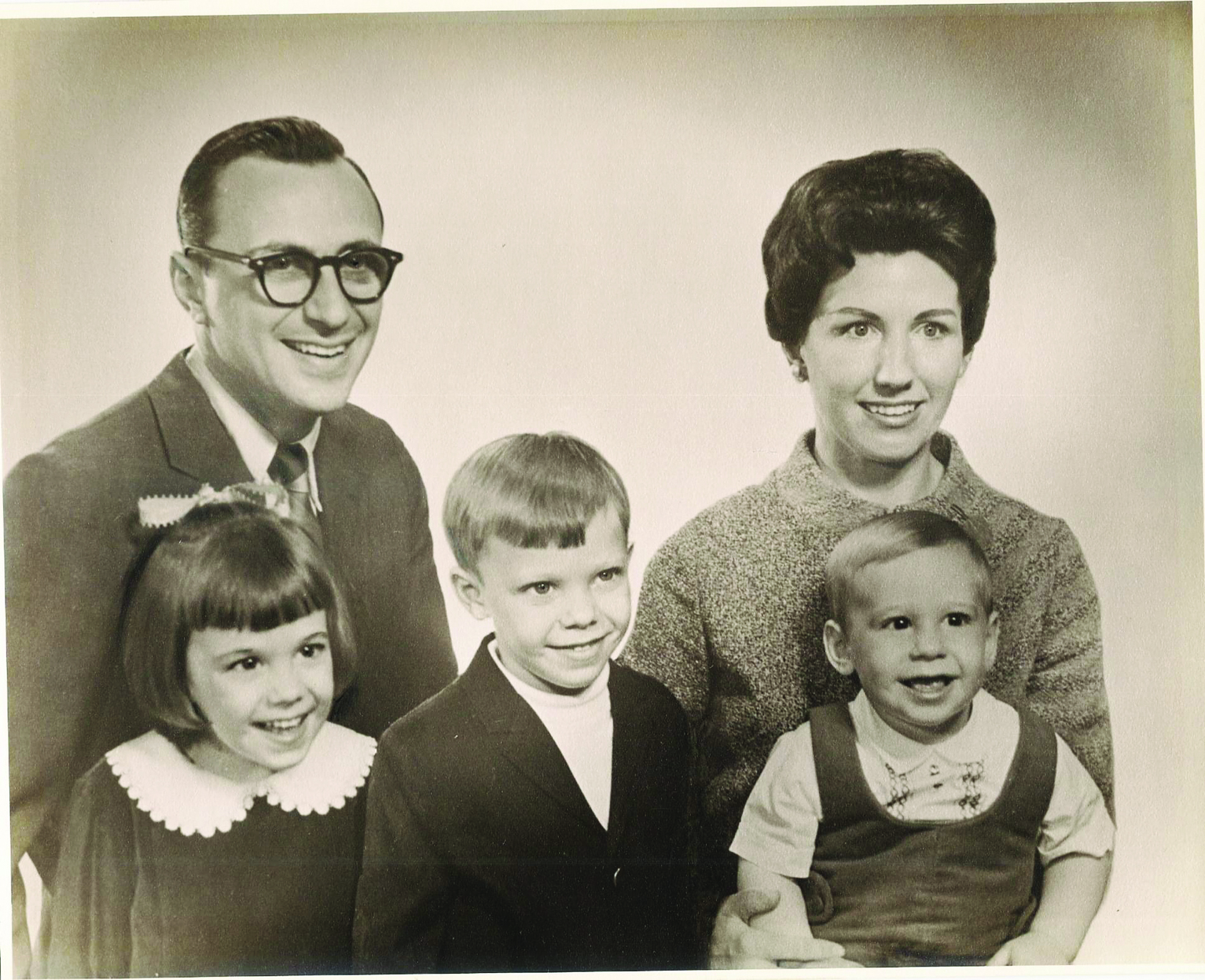
Tony got involved in sleep research psychiatry at UCLA, which according to Joyce was “wide open frontier” in the traditionally psychoanalysis-centric field. They moved to Pennsylvania in 1971 when Tony was named Psychiatry chair at Pennsylvania State University. But because of nepotism rules, Joyce couldn’t serve on the same department’s faculty.
Instead, she worked for the Department of Family Medicine until the rules changed. It was a roundabout way to come back to her chosen field, but it bore a silver lining of introducing her to community psychiatry.
She worked on a team of psychiatrists that traveled across rural Pennsylvania, presenting to school counselors and staff on topics like substance abuse, teen depression, anxiety, suicide, and eating disorders. At a time before adolescent mental health and school counselors were the norm, it was innovative.
“That was not being done in those days,” Helen said about her mother’s work. “It was unusual that they were getting out of the ivory tower and taking the show on the road.”
At Penn State, Joyce eventually was able to conduct extensive sleep research. Together, she and Tony founded the Penn State Sleep Research and Treatment Center and co-authored the book Evaluation and Treatment of Insomnia (1984), which is still regarded by many as “the book” on insomnia.
Joyce said the psychological aspects of medicine always drew her in first, whether it was in gynecology, surgery, or ENT.
As it turned out, the same natural curiosity took root in her daughter. Helen was a Spanish and biochemistry major at Bucknell University, where the sciences were on one side of campus and arts on the other.
“It was literally like the right brain and left brain moving back and forth, and I really liked that,” Helen said. “The idea of going to medical school appealed to me, but I specifically chose Rochester because [George Engel’s] Biopsychosocial Model had been created there. I believed, and still do believe, we should look at people that way.”
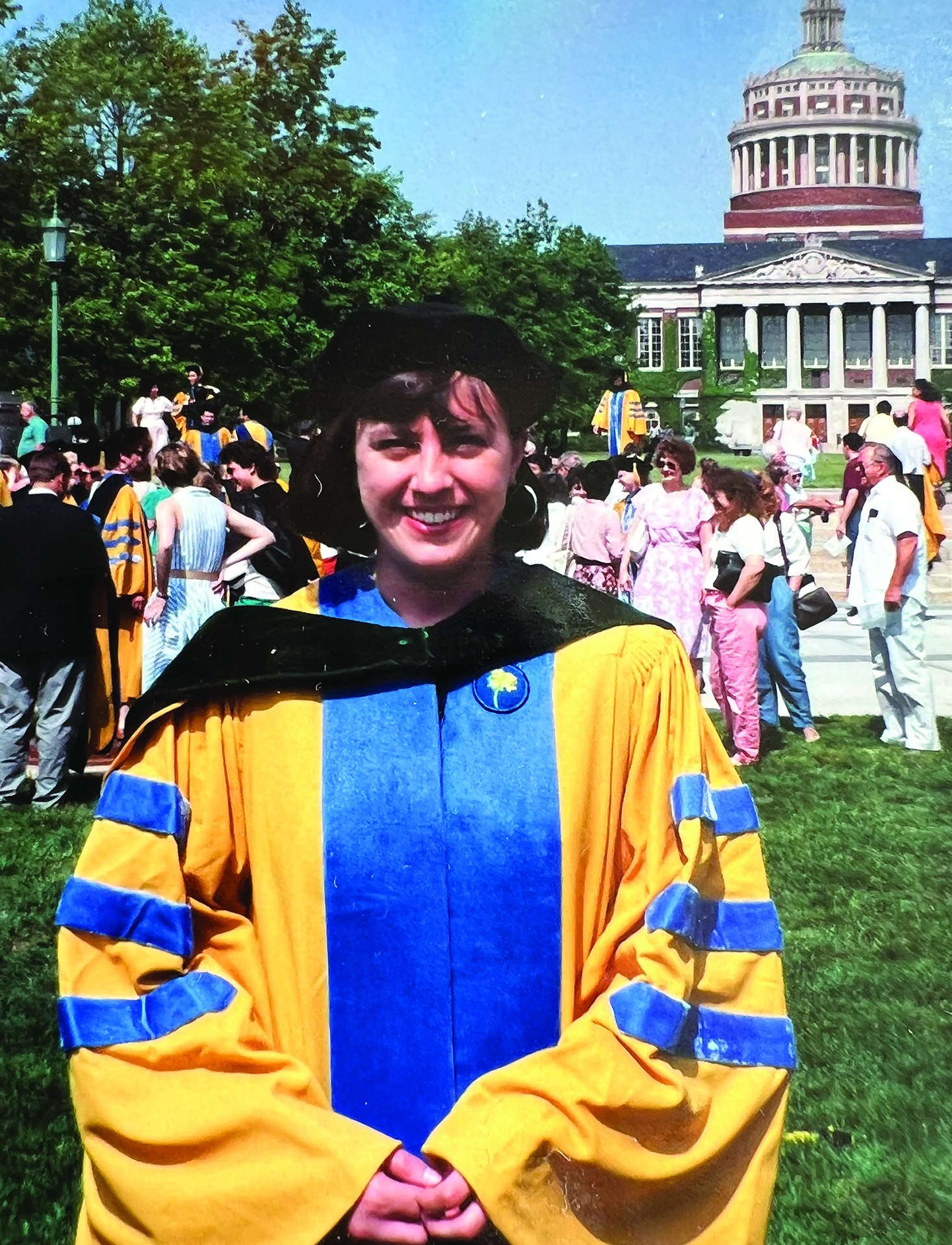
Ironically, Tony and Joyce also had learned from Engel. He was a visiting professor in their department at Penn State, teaching on treating the “whole person,” including the environmental factors that influence their behavior.
Despite the “family business,” Helen was encouraged to explore whatever subjects interested her. When she showed interest in Rochester for training, they thought about the link to Engel. “He was from Rochester, so I knew from the get-go that that would be a really good place,” Joyce said.
Ultimately, she chose medical school at Rochester, graduating in 1992. Much like her mother, Helen was naturally curious about the reasons behind people’s actions. On clinical rotations, she specifically wondered why physicians did home visits for OB patients who were reluctant to come in for care.
“That led me to think about personal and systemic barriers,” Helen said.
While at Rochester, she looked up to faculty mentors including Anton Porsteinsson, MD, and Mary Lou Myers, MD, who modeled how a holistic approach translated into clinical care.
Helen did her psychiatry residency and geriatric psychiatry fellowship at the University of Michigan, where she became a faculty member and excelled in research and teaching—specializing in geriatrics, specifically aging-related mental health and dementia treatment.
When Helen had a daughter of her own, grandparents “Yiayia” (Joyce) and “Pappou” (Tony) supported her the way they knew best. They were a constant presence in their lives, handling morning and afternoon rides for their grandchildren’s daycare. Their support continued through Tasia’s youth, into her college years and beyond.
Helen returned to the West Coast in 2019 to become chair of Psychiatry at UC Davis.
The American College of Psychiatrists awarded her the Geriatric Research Award in 2021 for her lifetime contributions to the field of mental health and aging.
In the ensuing years, their family went through many highs and a few lows. Tasia met her husband-to-be, who was welcomed with open arms by everyone including Yiayia and Pappou, who treated him like a grandson.
But Tony’s health started to decline around the time that Tasia decided to pursue psychiatry as a specialty. He was incredibly moved by her decision. “You’ll never regret this,” he told her. “I knew this was right for you.” Tony died in 2023.
Today, Helen reflects on the example set by her parents, who had successful careers but still managed to make family their first priority.
“In the ’70s, she was the only mom in the neighborhood who worked outside the home,” Helen said. “Yet my mom was really available and present, and that had a big influence on me. I never thought that I couldn’t be a doctor and a mother.”
‘No One Way’ to Succeed
While it was less common in her day, Joyce also remembers seeing working mothers who made an impression. She remembers working at a hospital as a pharmacy student, seeing a female physician going to deliver a baby while “hugely pregnant” herself. Later, she saw the same woman in the cafeteria with five children of her own.
“I said to myself, ‘Wow. I guess you can be a mother and a physician,’” said Joyce. “Having role models is very important.”
Her daughter, in turn, was profoundly influenced by what her mother went through in her career.
“I watched her resilience,” Helen said, “and that’s something I think we all need in medicine because it’s always changing and it’s complicated and there are a lot of barriers. But you know, the gratification, too, is pretty amazing.”
Today, both grandmother and mother proudly see that legacy continuing in Tasia, who is a PGY-2 psychiatry resident at the University at Buffalo. Like her mom, she grew up surrounded by psychiatrists (a point of humor in their family) and for her it was a foregone conclusion that she would go into medicine. Seeing both her mother and grandmother do it normalized what had once seemed out of reach for Joyce as a young woman. It was even more special when Tasia chose her mother’s alma mater for medical school, and psychiatry as her focus.
Their `family legacy is built on a strong foundation of love and mutual support. Joyce, now 90, lives in Florida but speaks daily with Helen and is a regular winner in the family Wordle competition. Tasia likewise speaks daily with her mom. Reflecting on their journeys, they share hope for the next generation despite the challenges—particularly for young women like Tasia. For them, Joyce shares this advice:
“People will say, ‘Well, how do you make it work?’ There’s no one method,” she said. “You’re balancing things all the time. Sometimes a kid gets sick or you get sick and things kind of fall apart momentarily. But you pick yourself up and you figure out a way. And there’s no one way. But you’ll figure it out.”
Author
