

URMC Mourns Passing of Philip Rubin, Pioneer in Radiation Oncology
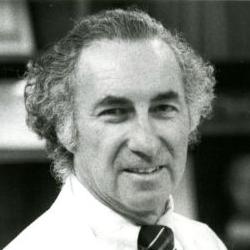
Philip Rubin, M.D., professor and chair emeritus of Radiation Oncology, died Sept. 24 at the age of 87. Among the founding members of what is now the Wilmot Cancer Institute, Rubin was a leader in establishing the field of radiation oncology and a pioneer in research on the late effects of radiation exposure and cancer survivorship. He was also a committed clinician, mentor and teacher.
Early in his career, Rubin led the radiation therapy services program at the National Cancer Institute. He then joined the University of Rochester Medical Center faculty in 1957. He created the Department of Radiation Oncology and served as its chairman until 1996.
From his analysis of once-classified data from World War II and the Manhattan Project, Rubin published extensively on radiation tolerance and became an international expert on the impact that radiation can have on normal tissue long after exposure. This work led him to study the use of radiation therapeutically and helped lay the foundation for contemporary research in cancer survivorship.
“Philip Rubin was visionary in many ways in terms of applying radiation to the treatment of cancers,” said Louis “Sandy” Constine, M.D., FASTRO, who was recruited to the University of Rochester Medical Center by Rubin 33 years ago and is now the Philip Rubin Professor of Radiation Oncology and Pediatrics. “He also understood that people cured of cancer had long-term side effects that needed attention.”
For more than 25 years, Rubin was principal investigator for a National Cancer Institute Clinical Experimental Radiation Research Interface Center grant. This program project investigated the effects of radiation on normal tissue in different organs, and it set the foundation of future research in cancer survivorship.
“Dr. Rubin was an energetic and brilliant physician scientist,” said Yuhchyau Chen, M.D., Ph.D., chair of the Department of Radiation Oncology. “He had a very creative mind and his thoughts and ideas had often been ahead of his time.”
Rubin was among the founders of the Radiation Therapy Oncology Group, a national clinical cooperative group funded by the National Cancer Institute. He founded the International Journal of Radiation Oncology, Biology and Physics, also known as the Red Journal, in 1974 and served as president of what is now the American Society for Therapeutic Radiology and Oncology (ASTRO) from 1977-1978. He was awarded an ASTRO Gold Medal in 1984.
Rubin contributed to and authored more than 35 books, including "Clinical Oncology for Medical Students and Physicians: A Multidisciplinary Approach," considered the foremost guide on the study and radiation treatment of cancer worldwide for more than 40 years. He most recently edited the two-volume text, “ALERT — Adverse Late Effects of Cancer Treatment,” published earlier this year.
“Dr. Rubin epitomized the true clinician-scientist and his accomplishments have impacted everyone within the field of radiation oncology,” said Jacqueline P. Williams, Ph.D., FASTRO, professor of Environmental Medicine and Radiation Oncology. “He always amazed me with his intellectual breadth and his never-ending search for answers, particularly in the field of normal tissue late effects, one of the largest impediments to the utility of radiation therapy as part of cancer treatment.”
In addition to his work as a researcher, Rubin was a dedicated physician who mentored generations of residents and researchers.
“Phil was like a tornado of swirling love, enthusiasm, imagination, warmth, and determination, traveling quickly over the land and sucking into his domain all who inadvertently, or in my case, purposely chose to swirl with him,” Constine said. “In his wake are people who have been profoundly affected by him — countless patients who are alive because of his personal care and pioneering cancer research, young physicians who he trained to be superb oncologists, and young scientists who he inspired to enrich our understanding of oncology. But most of all, in his wake are people everywhere who observed what it is like to live life with unquenchable passion. The entire world of radiation oncology and cancer therapy rose to a new level as a consequence of his remarkable skills, dedication, brilliance and creativity. The world is diminished by his absence, but was enriched by his presence.”
Rubin is survived by three children, five grandchildren and two great-grandchildren.
Author
