

Miracle Kids 2025: Levi Morris
At Golisano Children’s Hospital, more than 1,200 babies are cared for through the Neonatal Intensive Care Unit (NICU) every year. Some stay at GCH for a few days. Others a few weeks. The earliest pre-term babies may stay for several months.
Few babies ever experience the journey of Levi Morris: 471 days, from November of 2023 to February of 2025.
“This little boy has been through the ringer,” said his mother, Carrie Davids. “He is the strongest person I know, and he was only 1 pound six ounces and 11 inches when he was born.”
Carrie experienced a normal pregnancy, and she and her husband, Jon Morris, were excited about welcoming their first child. But three months before Levi’s February 2024 due date, Carrie woke up with severe chest pain and was rushed to the Strong Memorial Hospital Emergency Department. She was diagnosed with early-onset severe preeclampsia and admitted to the hospital.
“Things can change quickly, and being hospitalized allows for early intervention if necessary,” said Neil Seligman, MD, Professor in the Department of Obstetrics and Gynecology and one of the maternal-fetal medicine physicians who treated Carrie. Four days into her stay, Carrie couldn’t breathe, and Levi was compromised, so he was delivered in an emergency C-section at a little more than 25 weeks.
“While it’s always best for the baby to remain in utero for as long as possible, in this case Carrie’s health was in jeopardy because the preeclampsia was causing fluid to build up in her lungs while at the same time putting Levi’s health in jeopardy from restricted blood flow in the umbilical cord and growth restriction,” said Seligman.
Helping Levi’s Lungs Grow and Develop
One of the results of delivery at this early gestational age is that the infant’s lungs aren’t fully formed. Since his birth, Levi has been fighting continuous health battles involving his small size and his underdeveloped lungs. He spent his first months in the NICU. During his first week he suffered a blood clot in his leg along his PICC line, which could have been fatal. But that was only the beginning.
Levi was intubated for 116 days, with one failed extubation attempt during that time. Then, after a successful extubation, Levi was on nasal continuous positive airway pressure (CPAP) for about three weeks. His parents were approached by Patricia Chess, MD, MS, to have a discussion about a tracheostomy, a surgical procedure that creates an opening in the front of the neck into the trachea or windpipe. A tube is then inserted through the opening to provide a direct airway for breathing.
“This surgery would allow Levi more comfortable breathing and be better for him developmentally in the long run,” said Carrie. “So, we made the decision to go forward with it.”
In the weeks following surgery, the tiny infant also suffered from pneumonia and tracheitis. But he kept fighting. Carrie and Jon and the GCH physicians, nurses, and staff were right there alongside him.
Colby Day, MD, medical director of the NICU, was one of the neonatologists who cared for Levi. “Sometimes we see babies go two steps forward, then three steps back in their health journey,” said Day. “But Carrie and Jon stayed optimistic. They tackled everything head on and firmly believed Levi would withstand the challenges. This family overcame so many obstacles, and it was a privilege to be part of Levi’s care.”
Critical to Levi’s treatment was the GCH Small Baby Program, offered to families with babies born at fewer than 28 weeks’ gestation or less than 1000 grams birthweight. The Small Baby Program focuses on both the multidisciplinary care specific to the needs of extremely low-birthweight infants and on the support families need during a long NICU stay.
The program includes physicians, nurses, physical therapists, occupational therapists, child life specialists, advanced practice providers, lactation counselors, social workers, family partners, and others. They work to integrate families into their infant’s bedside care as early as possible during the NICU stay and empower them to be part of the medical team.
Staying Optimistic While Facing Challenges
Carrie and Jon hoped to take Levi home in June 2024, and then, more confidently, in August 2024. They acquired the recommended ventilator and used it at the hospital for two weeks in anticipation of bringing him home. But Levi couldn’t tolerate the weaning of some crucial medications, and at one point he suffered a cardiac arrest, requiring 16 minutes of CPR. “That was a very scary time, said Carrie. “Four to five times a day his heart rate would drop, and he would turn purple.”
As he got older, Levi was moved to the Pediatric ICU (PICU). He continued to have unexplained events in which he could not breathe when he was laid on his back, and had an incident when he was completely paralyzed just before his first birthday; he remained so for a week and a half. His lung disease was severe enough to require many adjustments to his ventilator type before finding settings that worked for him. “I think he was on every ventilator that Golisano Children’s Hospital owns at one point or another,” said Carrie.
Collaboration is Key
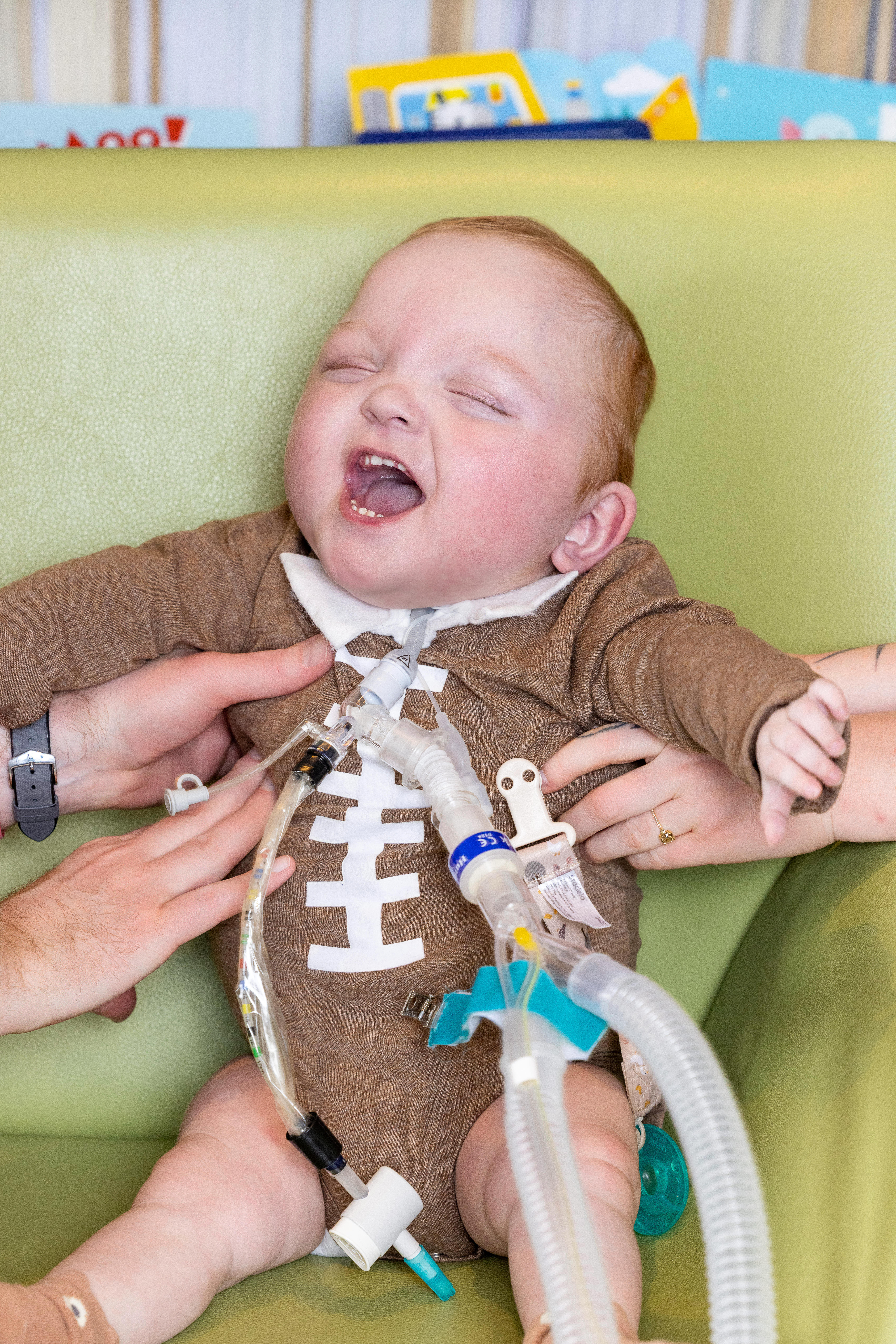
On November 19, 2024, Levi was successfully transitioned to a portable ventilator and began the path to going home. His first excursion outside the hospital was a visit to his home in Irondequoit. His parents were excited to introduce Levi to their dogs, Dixie and Ruby—although he slept through the momentous occasion.
“Levi’s condition was more severe than [that of] many of the children born at this early gestational age,” said Jill Cholette, MD, medical director of the PICU. “We are delighted with the progress that Levi has made as he faced many ups and downs through the course of his hospital stay. He has a special family and parents who have done great under a stressful and challenging journey.”
Levi’s parents were closely involved in his care throughout his journey. Carrie joined a social media group for parents of children with severe chronic lung disease. Levi’s care team partnered with colleagues within and outside of GCH to develop a strategy that worked best for Levi. Collaborators included Katie Palumbo, MD, an attending physician in the PICU who leads the LINC team (long-term integrated care).
Carrie believes that this level of collaboration and parent advocacy and involvement is critical in caring for a severely ill infant. “You have to determine how to best navigate the health system as a first-time parent,” she said. “You have to decide how to best advocate for your child and how to do it in a positive and collaborative way.”
Carrie and Jon were also supported by other parents—called Trach buddies and NICU buddies—experiencing similar challenges. These are programs set up by GCH and are examples of the GCH commitment to family-centered care.
“We provide the safest, highest-quality care in our NICU, PICU, and throughout Golisano Children’s Hospital,” said Jeffrey Meyers, MD, another neonatologist who cared for Levi and who is also associate chief quality officer of GCH. “Levi is still going to need a lot of care, but one of our major goals was to get him well enough to go home safely. That was an absolute team effort executed by so many physicians, nurses, therapists, care coordinators, multiple other providers, and his dedicated family.”
Home and Thriving
Despite all he’s been through, Levi has continued to grow and gain strength throughout this whole process, especially since he was put on ventilator settings that best support him. Levi was officially discharged on February 26, 2025, after 471 days in the hospital.
“Levi’s homecoming is a long time coming,” said Carrie, who beamed as she and Jon pushed their son in a stroller through the halls of GCH while dozens of providers blew bubbles and wished them well as Levi left for home. As part of his continued care, he will regularly see doctors from pulmonology, endocrinology, cardiology, neonatology, ENT, and GI/PANS and will have physical therapy, occupational therapy, and later, as his lungs grow, speech therapy.
One of his caregivers has been Laine DiNoto, CPNP-PC, leader of the Pediatric Tracheostomy/Ventilator Program at GCH, who started working with Levi and his family in December 2023 when Levi was still in the NICU.
“Caring for a baby on a home ventilator takes an incredible amount of time and dedication,” said DiNoto, who had recently seen Levi thriving at home. “When we think of kids who need support after birth, this kind of care does not immediately come to mind. But there are about 70 kids in our community alone who need this vital support. Achieving milestones is much harder for these babies, and providing appropriate care for them takes a special family. I am humbled to work with families like Carrie and Jon.”