

Miracle Kids 2025: Mary Sarah Hanna
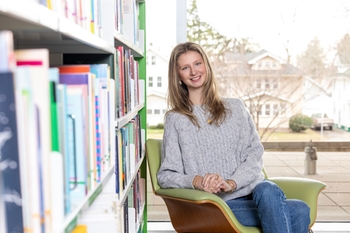
Karis Hanna never expected to perform CPR on anyone, let alone her own daughter. But on January 21, 2024, her swift actions saved the life of Mary Sarah, one of her six children.
On that day, 16-year-old Mary Sarah Hanna began a routine workout session at the gym with her sister. They were circuit training, lunging, and sprinting back and forth to warm up. Mary Sarah grabbed a pair of light weights and sat down on the weight bench to start the next exercise. Without any warning, she collapsed. Her heart had stopped.
The next 30 minutes were a blur of panic and quick thinking for Mary Sarah’s sister and her mother, Karis, who had been at the gym with the girls. Karis performed CPR for 12 minutes until the ambulatory team arrived and took over for an additional 15 minutes before Mary Sarah’s heart finally started again.
“Those first few moments without proper oxygen to the brain are so crucial,” explained Golisano Children’s Hospital (GCH) critical-care provider Jake Deines, MD. “CPR can push blood to the brain even if the heart is in distress. That can save crucial brain tissue and provide oxygen, preventing further brain damage.”
Her mother’s heroic actions saved Mary Sarah’s life, but her future recovery was still uncertain when she arrived at the Strong Memorial Hospital Pediatric Emergency Department.
The Arctic Sun: A New Treatment Option
Cardiac arrests are, thankfully, rare in children and teenagers, but when they occur, they’re often caused by respiratory issues or congenital heart conditions. In Mary Sarah’s case, her heart essentially short-circuited.
Though Mary Sarah was healthy, athletic, and young, she had an irregular heartbeat, or arrythmia. This caused ventricular fibrillation.
“There’s a complex electrical system that makes the blood flow in the right direction in the heart,” explained Deines. “Ventricular fibrillation is uncontrolled electrical activity in the lower parts of the heart. If the coordination of the upper or lower parts of the heart is altered, the blood flow can stop completely.”
Mary Sarah’s cardiac arrest resulted in a Hypoxic Brain Injury (HBI), which occurs when the brain doesn’t receive enough oxygen. Her doctors placed her in a medically induced coma for four days and suggested an intensive treatment—therapeutic hypothermia. This treatment involves cooling the patient’s core body temperature to help protect brain function after cardiac arrest.
“Though cooling after brain injury has been used for decades in patients of all ages, there's a lot about therapeutic hypothermia that is still unknown,” said Deines. “We're one of 45 centers in the United States participating in a national study, called P-ICECAP. We’re working to determine the optimal duration for cooling to best protect the brain.”
Mary Sarah’s family quickly agreed to participate in the study, hoping to give her the best chance possible. The P-ICECAP study involves using a targeted temperature-control device called the Arctic Sun, which cools the patient, monitors the temperature closely, and provides real-time feedback on the patient’s status throughout and directly following the cooling process.
Mary Sarah’s temperature was lowered to 91.4 degrees Fahrenheit and maintained for 24 hours before she was able to be rewarmed, awakened, and begin breathing on her own.
“The cutting-edge scientific research that we do here at the University of Rochester was crucial for Mary Sarah,” said Deines. “It allowed us to have the tools and expertise to help protect her brain in those critical days.”
At the time, the Arctic Sun was commonly used in the adult intensive care units but was relatively new to pediatrics at GCH. Mary Sarah’s success helped further prove its value for use with younger patients.
An Athlete’s Drive
Mary Sarah is one of six children in the Hanna family and an athlete like her siblings. At the time of her cardiac arrest, she had finished a successful soccer season and was preparing for volleyball. Her athleticism and determination, along with expert care, allowed Mary Sarah to leave the hospital after 32 days.
Following her admittance to the cardiac ICU, Mary Sarah’s recovery continued with acute inpatient rehabilitation, a service uniquely offered through UR Medicine. While in the unit, patients receive at least three hours of therapy a day, including physical, psychological, occupational, speech, recreational, and music therapy.
The Acute Inpatient Rehabilitation Unit opened in December 2023, with Mary Sarah, the unit’s first pediatric patient, being admitted the following month. The setting offered her an interdisciplinary team and environment designed specifically for individuals recovering from acute brain injuries. The secure unit includes private rooms with special safety features, such as glass doors that allow for 360-degree visibility for the patient and staff. The rooms allow for family to visit comfortably and be involved in the rehabilitation process.
Mary Sarah, like many patients in acute rehab, experienced a recovery period that moved quickly at first, then gradually slowed. She entered the unit unable to speak or move and began therapy right away. Her determination was immediately evident.
“Mary Sarah had a certain determination when she was on the field playing sports,” said her father, Thomas Hanna Jr. “And she has that same look doing physical therapy. When she was six months old, keenly observing her older siblings, she was counting down the time until she could start moving. That determination carried through her athletic career and then through her rehabilitation. It’s a credit to Mary Sarah and her competitive drive that she’s been able to overcome these challenges.”
Heather Ma, MD, MS, Division Chief and Medical Director of Acute Inpatient Rehabilitation and Chief of Brain Injury Rehabilitation Medicine, echoes Mary Sarah’s father. The rehabilitation care was paramount, but so was the Hanna family’s support and Mary Sarah’s grit and positivity.
“Mary Sarah is somebody who wasn’t going to take no for an answer,” said Dr. Ma. “She’s got a drive and resilience that I don’t have a pill for.”
GCH’s Human Touch
Hundreds of providers cared for Mary Sarah throughout her recovery, and many were there at every turn for her family, too.
“The support system the hospital gave to us as a family, in addition to the excellent medical care, I can’t say enough about it,” said Karis. “We were concerned about our youngest daughter, as she was at the gym with Mary Sarah. And our son was a senior in high school at the time and home on his own a lot. The social workers were there for them. They all took care of the entire family.”
For the Hanna family, it was the small details that made the biggest differences. Because of the nature of her injury, Mary Sarah doesn’t remember most of her time in the hospital in early 2024. Recently, however, she had to have a pacemaker placed and returned to the inpatient rehabilitation unit. She was shocked at how warmly and enthusiastically she was welcomed back.
“It was so nice. They were asking me questions about personal things they knew about me from earlier. I don’t remember anyone I worked with originally, but it was like they all knew me,” said Mary Sarah.
In particular, the staff remembered Mary Sarah’s love for Starbucks. It was the first thing she asked for when she awoke in February 2024, and when she returned for additional care, they had coffee from Starbucks waiting for her.
Another detail was Mary Sarah’s height. The pediatric unit didn’t have a bed that would fit her 6’3” frame when she was first admitted and had to track one down. The second time Mary Sarah was treated, the bed was ready before she arrived.
“The doctors, the nurses and technicians, and even the facility employees were so deferential, with a very human touch. Empathy seemed to run through everything, and it wasn’t pity. They cared,” said Thomas.
Mary Sarah’s providers cared so much that they even helped her celebrate Homecoming when she missed out on it at her school. Donning a tiara and a sash and reuniting with the people who had helped her so much earlier in her treatment, Mary Sarah experienced a different, but equally special, kind of homecoming.
Adventure Awaits for Mary Sarah 2.0
Mary Sarah has accomplished many of her progress goals in physical therapy over the last year. She can now run, jump, and skip, and most important, hike.
Next fall, Mary Sarah will be exploring mountaintops at Appalachian State University, Boone, NC, where she plans to study construction management.
Mary Sarah’s recovery is not yet complete, but she is more determined than ever to continue moving forward. “I like to say that this is the Mary Sarah 2.0,” said Ma. “She’s not better, she’s not worse, but she’s different.”
Part of what makes Mary Sarah 2.0 different is the way she learns. She struggles with short-term memory and processing certain details, which is a challenge in school. But even with the added obstacles, Mary Sarah is taking AP-level classes this spring and is looking forward to the next step in her education.
“It’s frustrating having to learn how to study differently, having to record lectures, go to a different place for tests,” Mary Sarah said. “But I’m really excited for college.”