

Miracle Kids 2025: Kennedy Brach
Beverly Brewer, RN, is a lactation consultant at Golisano Children’s Hospital’s Division of Breastfeeding and Lactation Medicine. Each week, she leads a support group for mothers in the region, helping them navigate the challenges of early parenthood through emotional and physical support. Her role is to uplift others—but one evening last fall, she found herself in need of support.
After concluding a session, Brewer walked outside to find her car stolen. Worse, this was the second time it had happened in a month. In that moment of distress, a regular attendee of her group, Alexandra Walker, stepped in.
“Alex said to me, ‘I’m not going to leave you here. I’m waiting until the cops come,’” Brewer recalled. “She was always concerned about me, even though I knew what she was going through.”
A Difficult Start and Growing Concern
Alex’s journey with her daughter, Kennedy Brach, began with unexpected challenges. Her water broke at around 29 weeks of pregnancy, and she was admitted to GCH’s NICU in hopes of delaying delivery until 37 weeks. “Kennedy had other plans,” Alex said. She was born at 30 weeks.
Moderately preterm babies frequently have positive outcomes with the right interventions, but Kennedy faced a few hurdles. The typical intervention, caffeine, for underdeveloped lungs for babies at 30 weeks was less effective. Kennedy required respiratory support and spent six weeks in the NICU. Still, by the time she was discharged, she was thriving.
“We came home with a healthy baby who had some complications,” Alex said.
Many of these complications were typical for babies born at 30 weeks—ophthalmology visits for premature eyes, developmental monitoring, and a breathing apparatus for the first few weeks. But as time passed, Kennedy’s biggest challenge emerged.
Soon after discharge, she began to develop feeding issues. What started as mild reflux and suspected allergies soon escalated into a severe feeding problem. Kennedy struggled with both breastfeeding and bottle feeding, unable to complete a full feeding session.
“She would take a couple of sips and then gasp for air,” said Alex. “She would struggle to get her required amount for two hours, and in the process, she would burn more calories trying to eat than she would take in.”
As Kennedy failed to gain weight, concerns mounted. She fell below the growth curve and received a failure-to-thrive diagnosis. Specialists from gastroenterology, ENT, and speech therapy worked to determine the cause. Despite trials of reflux medications, dietary eliminations, and countless formula changes, nothing provided a clear solution.
“We tried everything,” Alex said. “It was a relentless cycle of trial and error with no real answers.”
A Lifeline in the Division of Breastfeeding and Lactation
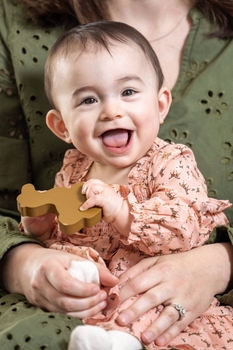
During this exhausting process, Alex found critical support from Casey Rosen-Carole, chief of the Division of Breastfeeding and Lactation Medicine.
“There were so many specialists involved, and Casey was the one who made sense of it all,” Alex said. “She tied everything together, ensuring that each specialist’s input was part of a cohesive plan. When the anxiety of it all felt overwhelming, she helped us figure out a way forward. I can’t say enough about her team.”
Formed in 2022, the Division of Breastfeeding and Lactation Medicine at GCH is one of the few dedicated divisions of its kind in the country. As an independent, multidisciplinary group, it provides a wide range of services, including latch assessments, medication management, treatment for tongue-tied infants, and support for struggling feeders like Kennedy.
“Our division exists to serve patients exactly like Kennedy,” Rosen-Carole said. “While we want to help mothers achieve their breastfeeding goals, we also address all feeding issues and coordinate care across multiple specialties.”
Breastfeeding expertise is unique to URMC. It’s where Ruth Lawrence, an icon of the field and co-author of the landmark textbook on breastfeeding, Breastfeeding: A Guide for the Medical Profession, spent her entire career. Lawrence also founded the Breastfeeding and Human Lactation Study Center in 1985, where she served as director. This center became a cornerstone in the study and promotion of breastfeeding, reflecting her dedication to improving infant nutrition and maternal health.
The principles that drove Lawrence’s work a half-century ago are relatively unchanged in the present day: Breastfeeding, and feeding in general, is a serious practice that requires diverse expertise, treating the whole patient, and listening to patient needs, which Rosen-Carole helped deliver for the Brach family.
“Casey (Rosen-Carole) empowered us as parents to handle and juggle everything,” said Alex.
In addition to Rosen-Carole, Alex found emotional support in Brewer’s breastfeeding group for high-risk parents. “It’s hard for moms to come to a group when everything is going wrong and hear others say, ‘Hey, everything is great,’” Brewer said. “But in our group, they feel accepted because everyone shares in the struggle.”
Despite the stress of Kennedy’s feeding difficulties, Alex reciprocated the support she received from the group by paying it forward for others. She never missed a session and invited other mothers she had met in the NICU and through online forums, making sure they knew they weren’t alone. She even demonstrated infant massage methods from head to toe, which had never been done before in the group, according to Brewer.
Her presence ultimately became a cornerstone toward helping Brewer build a supportive environment. “She’s consistent and brings others in,” Brewer said. “Alex has a huge smile, even during tough conversations. She’s always supporting others, which brings a special energy to the group.”
Finding Answers and Showing Appreciation
After months of uncertainty, clinicians determined that Kennedy was likely experiencing both suck dysfunction—an issue with the sucking process—and a swallowing disorder. With the help of speech and language therapy, dietary adjustments, and continued monitoring, Kennedy finally began gaining weight and reaching milestones.
“It’s still her biggest challenge, but we have the right people involved, and we’re getting closer to a solution,” Alex said. “We’re no longer losing sleep at night.”
A key part of Kennedy’s care now involves GCH’s Aerodigestive Collaboration program, led by Margo McKenna, MD, Director of Pediatric Otolaryngology. This service brings together multiple specialists to tackle complex feeding issues like Kennedy’s.
“The program is really designed to treat patients like Kennedy, who have multi-factorial, complex dysphagia,” McKenna said. “We have specialists from multiple fields (ENT, GI, allergy, and others), all talking together to find solutions and help create a personalized treatment plan.”
Now past the sleepless nights and marathon feeding sessions, the Brach family can finally breathe a little easier. Rosen-Carole and Brewer credit Alex’s persistence and optimism with helping Kennedy thrive. “The parents have been incredible advocates for Kennedy, working patiently to find the right providers and treatments,” Rosen-Carole said.
“Alex is so attuned to what Kennedy needs, and she’s built a village around her to support her,” McKenna added.
For Alex, this includes the medical team that has guided them through this journey.
“They say it takes a village to raise a child,” she said. “But for us, so much of that village has been our medical providers. They’ve given us the greatest gift: a happy and healthy child.”
