

There is No Cure for Multiple Myeloma – but a Clinical Trial Brought One Patient Hope
Nadine Poormon had a broken arm, but she had no idea why. A trip to urgent care and an MRI led to a shocking discovery: She had cancer.
Her diagnosis was a rare type of blood cancer called multiple myeloma, which develops in a person’s plasma cells that help fight infection.
There is no cure for multiple myeloma. But a cutting-edge clinical trial is helping give patients like Nadine more time.
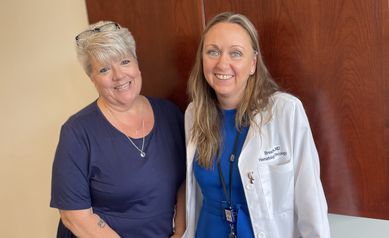
First, after her diagnosis in 2017, Nadine had to have two surgeries, to remove the tumor and then to place a rod in her arm. After surgery, she met her oncologist, Brea Lipe, MD, and her nurse practitioner, Gina Fries, PA-C. She credits both—and many others at Wilmot Cancer Institute—with saving her life.
“I thank God every day for both of them and for that whole group,” Nadine said.
She needed a stem cell transplant, which required a three-week stay at Wilmot, where she says the team took wonderful care of her. She recalls one medical tech who would come and chat with her in the night about gardening and cooking—anything but cancer—to take her mind off what she was going through.
Another night, when her hair began to come out in clumps, a tech offered to cut her hair for her, right then and there, so she wouldn’t have to deal with it slowly falling out one clump at a time.
“They're fantastic,” Nadine said. “It's so hard to put into words how grateful I am for those people.”
Nadine also had chemotherapy, which helped for a while. But the myeloma returned. In 2022, Lipe told Nadine about a clinical trial for a brand-new treatment for multiple myeloma: CAR T-cell therapy. Early trials had shown good promise.
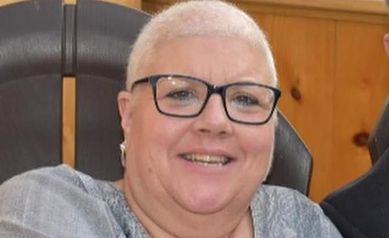
The cutting-edge method extracts T cells, which help fight infection, and changes them in the lab to make them better at fighting cancer. The cells are then reinfused into the patient.
The treatment has been used in other types of blood cancer, including lymphomas and leukemias. Wilmot Cancer Institute has nearly a decade of experience in CAR T-cell therapy, having been among the first to offer a clinical trial for it in 2016. Wilmot was also among the first 20 sites in the world to offer the therapy commercially for a specific type of lymphoma. Today, there are two CAR T-cell therapy products approved for multiple myeloma; Nadine received ciltacabtagene autoleucel, also known as cilta-cel (Carvykti), in her clinical trial.
Nadine decided to participate in the trial for two main reasons. First and foremost, she had a grandchild arriving soon. She needed to make sure she was around to meet him, and the clinical trial seemed to give her a great chance of that. Secondly, she saw it as an opportunity to help others.
“If the information that they get from me can save another person's life and let them live a long life, or save a child, then I’m good with that,” she said.
She was one of about 400 patients across the nation to participate in that particular trial, known as CARTITUDE-4. A paper published in 2023 reported that more patients with the CAR T-cell therapy survived at least 12 months without the cancer progressing compared to the chemotherapy standard of care.
The success helped lead to CAR T-cell therapy being used earlier for patients with multiple myeloma. Additionally, data from one of the previous trials, CARTITUDE-1, was presented at the 2025 American Society of Clinical Oncology (ASCO) Annual Meeting and showed about one-third of patients remain in remission five years after receiving the therapy without being on any other treatment.
“Multiple myeloma is incurable, so it is exciting to see patients doing well with CAR T-cell therapy,” says Lipe. “Because of clinical trials, we have more options to provide our patients that often help give them more time or a better quality of life.”
While the treatment has helped Nadine, it has not gone without challenges. She has some side effects. Her immune system is weak, so she gets sick easily. She also needed pain medication, but she’s working now with the UR Medicine Palliative Care team to reduce or wean off it.
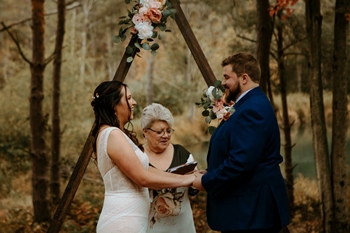
It’s not easy, but she has not needed treatment since she had CAR T-cell therapy, and she is grateful for her Wilmot team and for the clinical trial that has given her more time. She recently retired and is looking forward to checking items off her bucket list, including an upcoming whale watching trip in Massachusetts. She also became a marriage officiant two years ago so she could help a co-worker and friend celebrate her big day.
But the item at the top of her list is her two-and-a-half-year-old grandson.
“I want to watch him grow up,” she says. “I just adore him.”
When her radiation oncologist told her that she was clear of cancer for now, her first thought was to thank some of the nurses who cared for her. They lit up when she shared the news.
“I’ll tell them a million times over how much I care about them,” she says. “I would give them all a Medal of Honor. They are heroes.”
Author
