

New Pharmacy Program to #EndtheEpidemic
The Remarkable Evolution of HIV/AIDS Treatment
HIV/AIDS was a death sentence. Until LGBT people, people living with HIV, and allies demanded action and pushed the scientific establishment to address the crisis. What followed is nothing short of extraordinary.
First came the discovery that AZT (azidothymidine), a drug previously abandoned as a failed cancer treatment, suppressed HIV replication in a petri dish without killing normal cells. Under significant pressure from activists and the public, the FDA fast-tracked testing and review, and approved the drug to treat AIDS in 1987. It worked.
While effective, AZT was initially prescribed at a very high dose, with a demanding schedule, and significant toxicity. Researchers trialed a reduced dose and found it to be effective. They then recognized that AZT could be used in patients with HIV to prevent or slow the progression to AIDS. Building on this success, scientists developed additional antiretrovirals in the same class as AZT, nucleoside reverse transcriptase inhibitors, or NRTIs.
Unfortunately, AZT and other NRTIs could only effectively fight the virus for a limited period, due to HIV’s ability to mutate and develop resistance. This caused researchers to conduct trials in the early-to-mid 1990s comparing the efficacy of two-drug regimens over AZT alone. In patients naïve to AZT, combined drug therapy was superior. However, there was no comparative benefit for patients who had previously been treated with AZT alone—further emphasizing the challenge of antiretroviral resistance.
1996 brought a huge breakthrough. For the first time, scientists trialed triple-drug therapy, incorporating a drug from a newly invented class, protease inhibitors. Highly active antiretroviral therapy (HAART) was born. Studies showed that HAART could fight the virus and lower the amount of viral RNA in the blood to undetectable levels. Crucially, HAART sustainably reduced viral load in patients who had previously been on single-drug therapy, demonstrating its success in overcoming drug resistance.
Triple-drug therapy came at a cost—literally and figuratively. The drugs had severe side effects and had to be taken according to strict and complicated schedules. Medications only work if they are taken as prescribed, and these were significant barriers to adherence.
Drug discovery continued to simplify the regimens and reduce the side effects. Today, there are over fifty medicines approved to treat HIV, representing seven drug classes. Treatments that required twenty pills a day in the 1990s are now delivered in one pill. Some treatment regimens can be delivered through monthly or bi-monthly injections. Far from a death sentence, HIV is a livable chronic disease.

The Next Miracle: Preventing HIV
The scientific battle against HIV took another major leap forward in 2012, when the FDA approved the use of a pill combining two antiretrovirals, emtricitabine and tenofovir disoproxil fumarate (brand name: Truvada) to prevent HIV transmission. It has been extraordinarily effective, preventing roughly 99% of potential infections.
Mirroring the expansion of HIV treatment, the options for pre-exposure prophylaxis (PrEP) have expanded and become less burdensome over time. There are two FDA approved formulations for oral PrEP, emtricitabine/tenofovir disoproxil fumarate and emtricitabine/tenofovir alafenamide (brand name Descovy). Descovy is not currently approved for use as PrEP in people assigned female at birth. Alternatively, patients who are at risk of acquiring HIV through sex can opt for an injection of extended release Cabotegravir every other month.
In addition to PrEP, post-exposure prophylaxis (PEP) is highly effective at preventing infection when taken within 36 - 72 hours after known or possible exposure. There are a few formulations of PEP available. For most adults, New York State recommends a single pill containing tenofovir alafenamide, emtricitabine, and bictegravir daily for twenty-eight days, or emtricitabine/tenofovir disoproxil fumarate daily plus either raltegravir twice daily or dolutegravir daily, also for twenty-eight days.
The Outpatient Pharmacy Rapid Response HIV Prevention Program
A key component of successful treatment or prevention of HIV is helping people access and take the highly effective medicines as directed. Accessibility is particularly important for PEP, as time is such an important factor.
The University of Rochester Medical Center has taken a big step toward greater availability and accessibility of PEP through the Outpatient Pharmacy Rapid Response HIV Prevention Program.
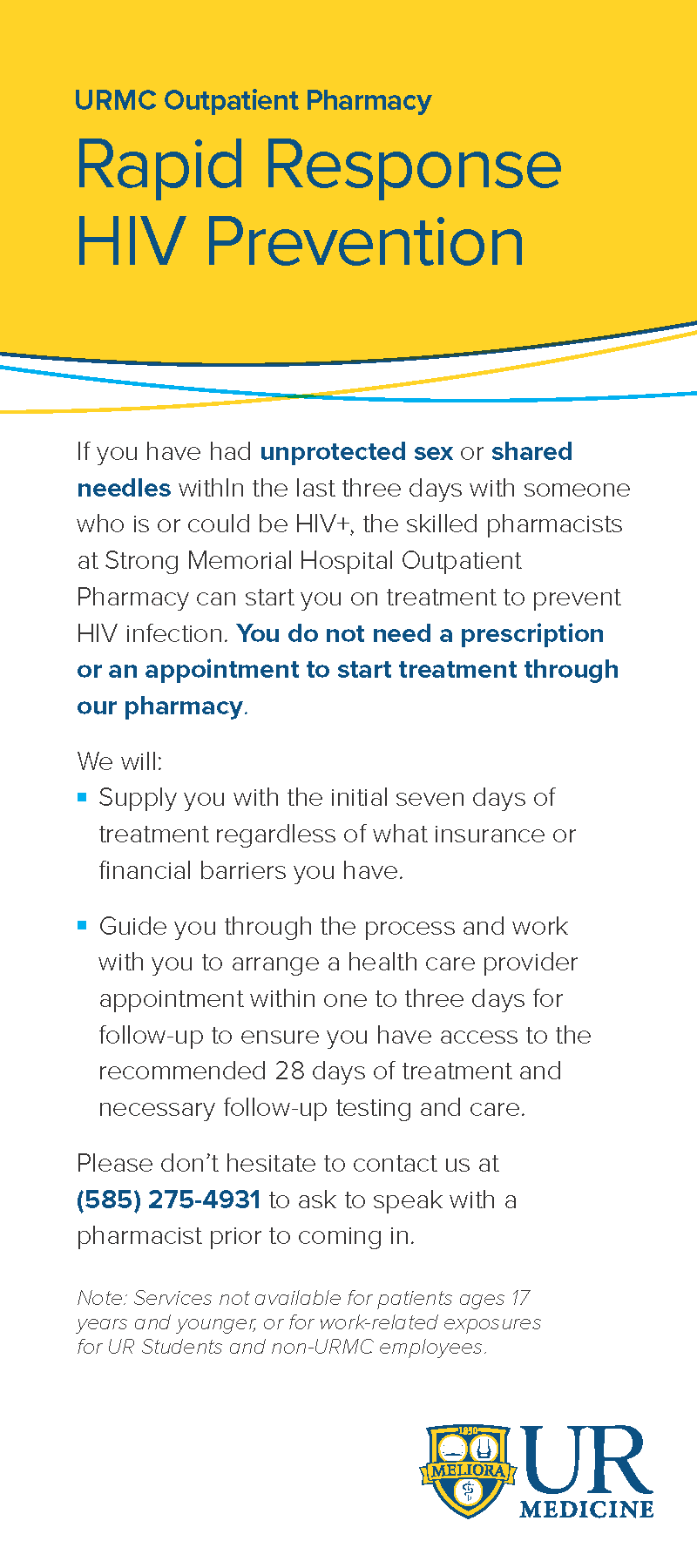
Under this program, anyone 18 or older who has had a non-occupational exposure or potential exposure to HIV can go to the outpatient pharmacy in the lobby of Strong Memorial Hospital and receive seven days of PEP, regardless of insurance coverage or financial need. No prescription or appointment is needed.
The pharmacist will also schedule an appointment for the patient with a health care provider within one to three days for necessary testing and to dispense the remaining twenty-one doses.
In just four decades, HIV/AIDS went from a mysterious, deadly disease to a preventable chronic illness. It is within our grasp to end the HIV/AIDS epidemic entirely through prevention, education, and effective treatment. Efforts like the Outpatient Pharmacy Rapid Response HIV Prevention Program at Strong Memorial Hospital are exactly what we need to end the epidemic.