

Achieving NCI Designation: What Did it Take?
Victory in hand, the Wilmot Cancer Institute is entering an exciting era.
But looking back to a gray day in March 2016, Wilmot Director Jonathan Friedberg, MD, MMSc, faced a steep climb.
On that Saturday, he had asked Wilmot faculty and staff and a handful of top leaders at the University of Rochester to sacrifice part of their weekend, sit alongside each other and say their piece: Should the cancer center apply for special designation from the National Cancer Institute?
The NCI is the federal agency, part of the National Institutes of Health (NIH), that coordinates cancer research nationwide. It offers a special designation to the most distinguished of the nation’s cancer centers.
The challenges to achieving this designation would be far-reaching, Friedberg told the group that day. It would mean collectively jumping over an exceedingly high bar—one that the NCI has been known to raise, without warning—and to pass a rigorous evaluation unlike any other in medicine.
Specifically, it would require years of preparation and change—which can be either a welcome guest or an interloper.
It would involve restructuring the entire organization, doubling Wilmot’s research funding, and converting the workplace culture from one that emphasized individual achievement to a team approach. It would require creating a bold strategic plan; meeting impossible deadlines; initiating innovative programs in education, training, and community outreach; recruiting topflight scientists and clinicians to Rochester; and winning unprecedented resources and commitment from UR leaders.
“Part of the difficulty was that a university is not a company and has many divergent goals,” says Wilmot Deputy Director Hucky Land, PhD. “We had to convince the University that cancer is a top priority.”
The Wilmot group that came to listen and learn on that Saturday in 2016 answered the multimillion-dollar question with a resounding “yes.”
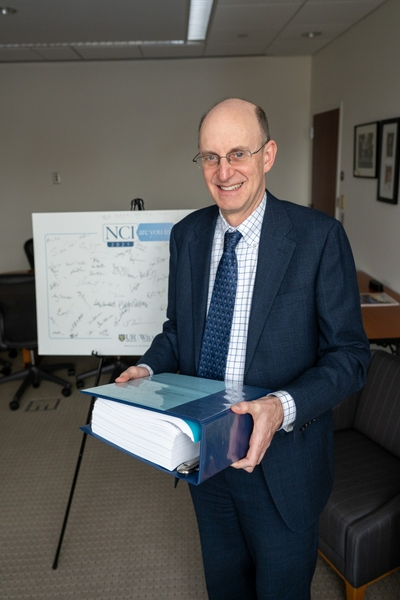
Friedberg left the meeting energized and with a symbolic artifact that has motivated him for years: A whiteboard signed by those who attended the rally, declaring they were “all in” to meet the NCI designation goal.
Wilmot had its own moonshot and set out on a bold mission.
In 2016, however, the Wilmot team could not have imagined the unseen challenges that would lie ahead, such as a deadly and historic COVID-19 pandemic that started in 2020 and would forever change lives and the workplace, and a shifting political climate with some in society questioning science and medicine in stunning new ways.
Making the Case
Still, Wilmot steadily made progress. The administrative group, led by Brian Martin, MPA, expanded and dove deep into the NCI requirements; it also assembled an external advisory board of highly regarded oncologists and scientists from across the country to coach and support Wilmot leaders in shaping the new direction.
At the same time, Wilmot established an award-winning IT team that would invent a homegrown mapping tool and collect data about cancer’s impact on the surrounding community and patient needs.
The sobering statistics about higher-than-expected cancer incidence in the region would go a long way toward proving to the NCI: Why Rochester? Why is designation at Wilmot needed, despite having other first-rate cancer centers in the state, including Roswell Park Comprehensive Cancer Center in Buffalo and several in New York City?
Data paint a clear picture that Wilmot’s patient territory is “a different New York” — set apart by the largest per-capita Deaf population in the country, and aging and impoverished residents from the city and from farming communities in the Southern Tier and Finger Lakes regions. In fact, 12 counties served by Wilmot are part of Appalachia, a region lagging the rest of the nation on many socioeconomic indicators.
Local, state, and federal government representatives supported Wilmot’s quest from the beginning. Rochester Mayor Malik Evans participated in a video for the NCI, driving home the “Why Rochester?” theme and sharing his own parents’ story of treatment at Wilmot.
Steps Toward NCI Designation
Meanwhile, Wilmot executives, with financial support from the University of Rochester, went on a recruitment binge.
Over several years, they persuaded 30 oncology stars from across the U.S., most of whom worked at other NCI-designated centers, to join Wilmot and lead more than 100 basic and clinical researchers. Collaboratively, the group set up three distinct research programs, focusing on how cancer cells work, how they interact with their surrounding cellular environment, and how cancer impacts people. They also built a community outreach program from scratch and invigorated the culture and raised expectations for what it means to be a designated cancer center.
Among these vital recruits was cancer epigenetics expert Paula Vertino, PhD, a secret weapon from Emory University who had served on NCI review committees and therefore gained inside knowledge of the designation process. Also: Ruth O’Regan, MD, with 20 years of distinguished experience as a clinician-scientist who agreed to serve on Wilmot’s executive team and lead the UR’s Department of Medicine; Paula Cupertino, PhD, a champion for solving health disparities; and Patricia Rivera, MD, an esteemed lung cancer specialist who shaped a robust screening program that is already seeing results.
“I cannot overstate how important all of the recruits are to Wilmot and to everyone who has helped to lift up the cancer center,” Friedberg says. “And it’s not only the dedication of faculty and staff during this long journey—but the steadfast support from University President Sarah Mangelsdorf, former Medical Center CEO Mark Taubman, and from Wilmot’s Advisory Board.”
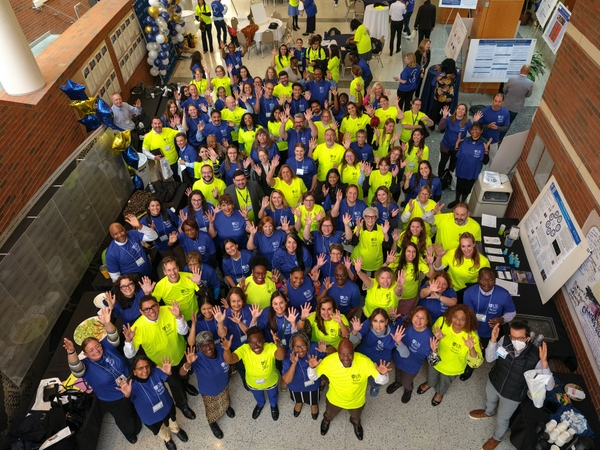
He also spotlighted Wilmot’s first Community Cancer Action Council (CCAC), a group created to inform research priorities and engage closely with Wilmot’s faculty and executives. CCAC members come from the public health sector, school districts, non-profits, advocacy groups, and faith-based organizations. The CCAC is an essential partner, and Friedberg meets with them monthly.
“They’ve showed us in new ways that it’s a two-way street between the cancer center and those who need our care,” Friedberg says.
In September of 2021, despite the burden of Covid on the health system, Wilmot leaders submitted an initial application to the NCI for the special designation.
In 2022, NCI reviewers asked for revisions and invited Wilmot to resubmit its application. The revised version went to the NCI in January of 2024. A customary lengthy review process occurred throughout 2024, including an NCI team in-person evaluation at Wilmot and the University of Rochester Medical Center in the spring of 2024. The process ended with formal designation in March 2025.
A Thriving Team Spirit
The challenging work for nearly a decade toward NCI designation broke down silos and opened doors.
Years ago, cancer scientists spread across the UR did not always know what their peers were doing. Collaboration was not top of mind. It took time to “adopt” these researchers and have them join Wilmot to reach common goals and begin “rowing in the same direction,” Friedberg says.
Now, these individuals are rooted in connectedness.
They attend structured meetings to share ideas and learn. They form teams across disciplines to work on projects unheard of in the past—for example, a cellular biologist might pair up with a population scientist who studies yoga interventions or an investigator who is trying to reduce smoking rates among Latino youths. They partner with the community to address the unique needs of upstate New York—and not just their own scientific interests. They compete for seed funding from Wilmot to fuel larger grants.
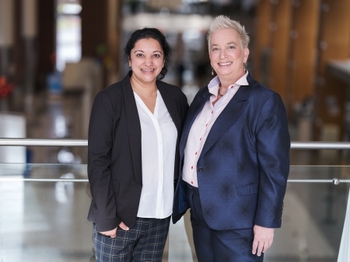
“To an investigator, there is always a ‘What’s in it for me? Why change?’” says Supriya Mohile, MD, MS, co-leader of Wilmot’s Cancer Prevention and Control research program. The answer to the hypothetical question, she says: “The science is better.”
Wilmot leaders also launched new cancer-focused education and training initiatives that include the Deaf community and supporters of cancer awareness and prevention services across upstate New York.
“We created a vibrant, active network that didn’t exist before,” says Karen Mustian, PhD, MPH, associate director for Population Science at Wilmot. “It’s brought excitement and confidence, and it fuels passion toward successful research.”
The camaraderie at Wilmot is not just professional.
More than ever, Wilmot administrators, leaders, researchers, and clinician-scientists are like family who celebrate and commiserate ups and downs.
For example, in May 2024, on the day when a blue-chip panel from the NCI was to arrive on campus, the Wilmot team was nervous as an intense vetting that was about to begin. They assembled in a holding room at 6:30 am and sipped coffee, looking uneasy.
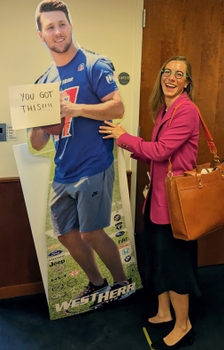
Suddenly, Jamie Flerlage, MD, MS, the effusive chief of pediatric oncology and a Wilmot clinical trials leader, strode into the room and broke the ice. She carried a life-sized cardboard cutout of Josh Allen—and a message from the beloved Buffalo Bills quarterback: “You Got This!!!!”
Before long, Wilmot leaders were taking phone selfies with cardboard Josh and were ready to win the game.
“There’s a new sense of pride and of belonging to this very special group,” Mustian says. “It’s like an entire team getting to go up to the podium to receive the gold medal. And that changes people. It makes us internally raise our expectations and set our sights higher.”
What’s Next?
A struggle common to all research institutions is finding ways to move laboratory discoveries faster and more efficiently into treatments for patients.
To clear this bottleneck, NCI designation allows creation of a major new program, called "Developmental Therapeutics (DT)."
Even among NCI-designated centers, DT is a rare niche, and Friedberg’s vision is for Wilmot to become a leader in DT—an elite program among the most elite cancer centers.
Essentially, Developmental Therapeutics is a formal drug-development plan of action that encompasses other novel treatments, such as advanced radiation and new types of immunotherapies.
Efforts are underway to recruit a DT leader and to fund a specialized laboratory with experts who have the training, experience, and distinct skills to design first-in-human clinical trials.
“It’s a thrilling place to be right now,” Friedberg says, "for research and for patients.”
Author
