

Why Research is the Backbone of NCI Designation
National Cancer Institute designation brings a cachet to the clinical side of any cancer center. So, it might be surprising to learn that achieving this highest honor is primarily based on research success.
The designation recognizes Wilmot Cancer Institute’s ability to advance science toward impactful treatments and to meet the unique needs of the community.
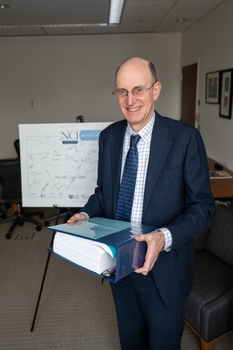
To emphasize the importance of groundbreaking science, NCI designation comes with a $10 million award, called a Cancer Center Support Grant (CCSG).
Wilmot submitted a 1,400-page CCSG application, which described the center’s research mission, funding streams, highlights of outstanding science, and leadership capabilities. Now that Wilmot has received the coveted CCSG, it must maintain the NCI’s rigorous standards and re-apply for the grant every five years.
Why Does Research Matter?
“It’s simple: because without research there would be no cancer treatments,” says Hucky Land, PhD, deputy director of Wilmot and chair of the Department of Biomedical Genetics at the University of Rochester.

“The CCSG honors this,” he says, “and provides an investment in the future.”
The multimillion-dollar grant is also a “carrot,” Land says, pushing scientists to accelerate their work—and to be mindful that patients must be able to benefit not only in future generations but more immediately.
The NCI insists upon teamwork and relevancy.
“The world is very complex, and you can only solve complex questions by collaborating closely with people from multiple disciplines,” Land says.
Immunotherapies, which have become sought-after cancer treatments in recent years, are an example of how patients benefit when scientists in different fields work together. These therapies harness a person’s own immune system to fight cancer.
It took 40 years before early discoveries suggested that immunotherapy could become a reality. But thanks to team science, an explosion of immunotherapies has become available in the past decade, and just since 2023, the U.S. Food and Drug Administration has approved two dozen new treatments. Teams are continually looking for ways to improve immunotherapies and broaden their versatility to help more individuals with a larger variety of cancers.
A Member of the Club
NCI designation provides access to a “very exclusive club,” Land says. Members can mine select data sets, tap into the most advanced technology, and work collaboratively with the nation’s top investigators to probe and answer the newest questions as they emerge on the cancer horizon.
To ready itself for this opportunity, Wilmot spent years restructuring its scientists and promoting teamwork—culturally and operationally.
What used to be loosely associated bands of faculty across UR morphed into three well-defined Wilmot research programs with membership criteria, goals, accountability, and shared visions. They are Cancer Prevention and Control; Cancer Microenvironment; and Genetics, Epigenetics, and Metabolism.
“What emerged was a Wilmot identity, a crystallization of an ‘us’ as opposed to a collection of individuals,” Land says. “That happens when you trust each other and you realize that together you’re much more powerful.”
In the end, cancer patients benefit as motivated research teams not only join forces but also turn toward the community, to seek input and ensure that their painstaking work connects to the needs of the people in western and central New York.
“We are getting ahold of cancer,” Land says. “It’s not a miraculous victory. It’s a protracted war, which we are clearly winning. Just look at the growing number of cancer survivors.”
Author
