

The Future is Bright: White Coat Ceremony Welcomes Medical Students to Profession
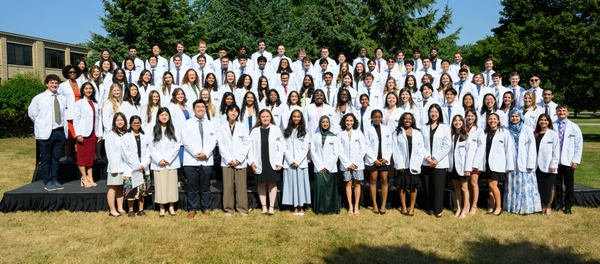
In a celebratory day filled with hope and excitement, the University of Rochester School of Medicine & Dentistry (SMD) held its 20th annual Dr. Robert L. & Lillian H. Brent White Coat Ceremony—officially marking the start of medical training for the school’s class of 2029.
This year, 104 students from across the U.S. and beyond, are part of the 100th class, as the school celebrates its centennial in September. Students wore pins to mark the milestone on their white coats, which they received as they crossed the stage as cheers of support rang out from friends, faculty, and loved ones.
David Lambert, MD, Senior Associate Dean for Medical Student Education, reflected on the 100th anniversary of the medical school’s first class of students. What would he say to the first class, if given the chance?
“I’d say thank you because they really forged the way,” said Lambert. “They would be as proud and happy, as all of our alumni are, that we’re still a great medical school with a research-based institution, owned by a university and continue to teach and embrace the biopsychosocial model which is key to Rochester’s past, present and future.”
At the ceremony, held Aug. 15 at the Alumni Advancement Center, speakers offered messages of support and encouraged students to respect the obligation that comes with wearing the white coat.
“The white coat that you receive today is more than just fabric and thread,” said University of Rochester Medical Center CEO and SMD Dean, David C. Linehan, MD. “It’s a promise to your patients, colleagues, and to yourself. It symbolizes trust, compassion, and the lifelong pursuit of knowledge. In the years ahead, you’ll learn to listen with empathy, to think with precision, and to act with integrity.”
Fourth-year medical student Alex Schick shared how her experience helped her see that medicine is about more than memorization and learning how to diagnose and treat patients. While all those things are important, she urged students to look at the big picture.
“Don’t lose sight of the simple but powerful act of being present with someone,” said Schick. “That’s where the real art of medicine lives.”
Keynote speaker Natalie Whaley, MD, associate professor of Obstetrics and Gynecology, described the profound symbolism that the white coat carries. It not only signifies expertise in medicine but—on a more practical level—it has deep pockets with room for supplies to help with the small, often mundane tasks as part of a team.
Whaley also said the white coat provides access to platforms where you can advocate on behalf of patients, ensuring policy and laws of our communities protect their most vulnerable people.
“The white coat signals our authority in society, our expertise and the responsibility we have to be the voice for patients both inside the exam room and beyond. This is what your training will afford you—the expertise and the position to use as an advocate in your workplace, your families, and your communities.
After receiving their white coats, students shared what the moment meant for them. Ramana Kolady expressed excitement at wearing the coat. He is interested in surgery but said he’s keeping an open mind about the future. For today, the ceremony was also a celebration of that support.
“It’s definitely exciting and makes me reflect on how privileged I am to be in this position,” said Kolady. “I know we’ve all put a lot of work into getting here but we wouldn’t be here without the support of our family and friends—everybody who helped us along the way. Right now, it’s important for me to reflect on all the people who helped me get here.”
This sentiment was echoed by classmate Tiana Grosskreuz, whose current interests are neurology and pediatrics.
“We’ve been waiting for this day for a long time and we’re just privileged to be here. Having the white coat reminds us we can really make a difference in everybody’s lives,” she said. “The power that comes with that is moving and it’s going to carry us through the next four years.
Fast Facts: Class of 2029
Average age: 23
Students come from: 27 U.S. States (most from New York, California, and Massachusetts), and Ghana
Countries of origin: 18 outside the U.S.
Languages spoken: 22
Graduated from: 55 colleges and universities; with majors ranging from economics and philosophy, to mathematics, engineering, and computer science, among others
Author
