

Personal Connection Anchors New Project with Golisano Children's Hospital, Onondaga Nation
The Onondaga are one of the five original nations of the Haudenosaunee (Iroquois) Confederacy that have populated Upstate New York since before the colonization of the Americas. Like most Indigenous peoples, their history with Western society, and, by extension, its institutions, has largely been one of exploitation. As a result, building a relationship with the Onondaga Nation requires a long-term effort that goes beyond meetings and contracts.
“Collaborating with us means understanding that we’re a sovereign nation with distinct protocols and procedures,” said Simone Gonyea, a member of the Onondaga Snipe clan and senior health project coordinator in the Department of Pediatrics’ Division of Developmental and Behavioral Pediatrics at the University of Rochester. “To work with us, you need to actively engage with all facets of the community.”
Gonyea helps coordinate a project between Golisano Children’s Hospital (GCH) and the Onondaga Nation aimed at increasing access to developmental and behavioral pediatric (DBP) care for Indigenous children and families. The project, which started in 2023, is led by Christina Mulé, PhD, associate professor in the Division of Developmental and Behavioral Pediatrics. The goal is to create a system of low-barrier care, improving the accessibility of DBP services for Indigenous children and their families.
Data from the National Survey of Children with Special Health Care Needs demonstrates that Indigenous children have the highest prevalence of special health care needs, at 16.6 percent, compared to 14.2 percent among non-Hispanic white children.
Gonyea, a former principal of the Onondaga Nation School with 22 years of experience working in the classroom, has seen this data reflected in the growing concern among the community. “This project is an opportunity to take a closer look at things that teachers and families were observing in their students,” she said.
“A number of children in the community have suspected developmental challenges, but due to stigma and difficulty accessing care, these children haven’t been identified and often do not receive the intervention services we would recommend they have,” echoed Mulé.
In the DBP field, resources are often stretched, even in affluent areas. The Onondaga Nation, like other Indigenous communities, faces inequitable access to care due to factors such as underfunding from Indian Health Services, lack of transportation in rural areas, and cultural differences that complicate bridging the divides between health systems and Indigenous populations.
Mulé became aware of these issues after reaching out to an Onondaga community member upon her return to Rochester, NY, from Boston, MA, where she spent the larger part of her early career at Tufts University School of Medicine. Thanks to seed money due to DBP’s University Center of Excellence on Developmental Disorders (UCEDD) designation, she was able to partner with the Onondaga Nation School, beginning school-based supports. Mulé’s pilot work eventually resulted in a $1M grant from New York State’s Council on Developmental Disabilities, which will support her work for five years and help her to extend DBP services across the medical and school sectors.
“I’m very interested in addressing health disparities and service inequities within developmental pediatrics,” said Mulé. “There’s a national shortage of specialists in our field, and waitlists are long even for families who know how to navigate the system. But what about the families who don’t know how to?”
Establishing Connection
Mulé’s personal background uniquely positions her to build the necessary trust within the Onondaga community. As a mixed-race, second-generation Korean American who grew up in LaFayette, NY, near the Onondaga border, she formed friendships with the Indigenous community early on, finding kinship in a predominantly white environment.
“I spent a lot of time on the ‘rez’ as a youth playing softball and cheering on the boys at lacrosse games,” said Mulé. “Those friendships were meaningful and helped me feel secure in my own racial identity.”
According to Gonyea, Mulé’s personal experiences have been key in establishing the foundation for the project. “She understands the community, having been connected as a youth. She supports us, inquires naturally, and knows when to pause—because she respects the culture,” Gonyea explained.
The scope of the project includes promoting developmental health, increasing developmental screenings, and improving access to developmental evaluation and intervention. This involves building capacity at the Onondaga Nation School and within the broader community. Patience is essential, however; while urgency often dominates the DBP world, the Onondaga Nation has experienced a long history of marginalization, from broken treaties to land appropriation and racial discrimination.
“A lot of this work is about developing allyships and friendships to break through the historical mistrust of Western institutions,” said Mulé. “You have to make a personal connection—and understand that reciprocity is fundamental to working successfully with Indigenous people.”
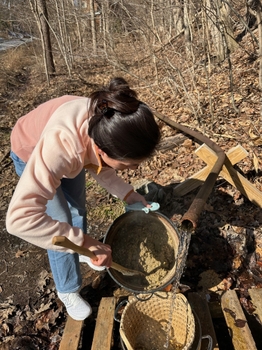
Mulé has made a genuine effort to establish these connections and has been humble enough to admit when there have been cultural missteps along the way. To help guide the work and build a partnership that is respectful of the Nation’s sovereignty, she and Gonyea have made concerted steps to connect with Nation leadership—the Longhouse, comprising nine clans each led by a Clan Mother who selects the Hoyanes (chiefs; the Onondaga have 14), including the Hoyane who represents the Nation in council—to gain approval for the project. Equally important, Mulé has immersed herself in the community, joining social activities on the Nation, including participating in a women’s book club, learning cultural practices such as making corn soup, and regularly eating at the Firekeepers Diner, a social hub of the community.
“Some of those social connections lead into doing the work, but mostly it’s about people getting to know me, which eventually fosters trust. It’s not just about sharing what I do professionally, but sharing about who I am as a person,” said Mulé.
“We’ve had previous projects with the University of Rochester Medical Center, but they were more academic in nature,” said Gonyea, “This is a much deeper effort that Christina is engaging in.”
As Gonyea and Mulé enter year two of the five-year grant, they are fully engaged in all aspects of the grant objectives, which include (1) engagement in bidirectional knowledge-sharing that improves partnership between GCH and the Onondaga Nation; (2) workforce training and technical assistance to educators serving Indigenous children with developmental disabilities—enhancing the ability for children to remain in their community school, which is rich in culture and language; (3) developmental promotion through community education initiatives; and (4) access to timely developmental and behavioral pediatrics screening, evaluation, and intervention.
“We’re currently building a support network and raising awareness,” said Gonyea. “We want to reach a point where a family member or teacher with questions knows exactly where to go for help.”
As the project continues to progress, Mulé hopes this connection can help sustain the project beyond the initial five-year run, leading to long-term infrastructure that will enable the next generation of Onondaga children to thrive.
“The goal is to serve as allies and advocates for the community and bring needed developmental services to the Nation that are respectful of their cultural heritage and sovereignty.”
