

The Long Game: Unraveling the Adolescent Brain
Mary Petersen was living in Utah with her husband and six children when an ad in the newspaper caught her attention. “I thought it was a fascinating research proposal that they were doing to really track the development of teenage brains,” said Petersen. “My husband is a researcher, so we understand the research process and the impact that it can make.”
The ad was for the Adolescent Brain Cognitive Development Study (ABCD Study), the largest long-term study of brain development and child health. Funded by the National Institutes of Health (NIH), 21 research sites across the U.S. started recruiting in 2015 and collecting regular data from more than 11,000 children in 2017, tracking their biological and behavioral development from adolescence into young adulthood.

Sisters Elizabeth (left) and Susannah Petersen, not long before they started participating in the ABCD Study.

Susannah (left) and Elizabeth Petersen today. They are two of the 11,000 participants in the ABCD Study.
Elizabeth and Susannah Petersen were 10 & 8 when the study started.
“It’s been really fun,” said now 16-year-old Susannah Petersen. “It’s not something that I would have done without my parents taking the initiative, but I’m glad they did.”
“I like being able to talk with the scientists about things they do. I’m actually looking into a career in science, so it has been really cool to see what science looks like on a day-to-day level,” said Elizabeth Petersen, 18, who enrolled in the study when she was 10. “I’ve seen a couple of ABCD Studies pop up, and I think that it is awesome seeing what my little contribution has been.”
In 2022, the Petersen family moved to Rochester and joined the more than 350 kids in the University’s cohort.
“The data has given us insight into sleep, mental health, screentime, substance use, and even, serendipitously, the impacts the pandemic has on the developing brain,” said John Foxe, PhD, director of the Del Monte Institute for Neuroscience at the University of Rochester and one of the principal investigators of the ABCD Study site at the University. “The Rochester community is contributing to our knowledge of brain development that will inform national health policy, which means the needs of our community are also being met.”
Longitudinal Studies Transform Health, Joy, and Disease
-
Framington Heart Study
This is one of the first long-term cohort studies funded by the National Institutes of Health and is “considered the crown jewel of epidemiology.” It has changed the course of cardiovascular disease—by bringing to light modifiable risk factors that mainly cause it.
- Harvard Study of Adult Development
This study began following students during the Great Depression to learn what leads to healthy and happy lives—it continues today and has revealed, among other things, that happy relationships are important to our overall health.
- Baltimore Longitudinal Study of Aging
This study began in 1958 and is the longest national study on human aging. Led by the National Institute on Aging (NIA), it continues to make major contributions to our understanding of what it means to get older, including that all humans age differently. In terms of development, there are more differences between young than older people.
-
Seychelles Child Development Study
Since 1986 a team of URMC researchers have led this study to understand the impact of daily fish consumption during pregnancy on the developing brain. What they found has shed light on misconceptions about the possible risks of mercury exposure from eating fish. Their findings set the stage to further our understanding of lifespan health outcomes related to fish consumption.
Open Data = Open Window into Brain Development

If printed, the stack of research papers published using the data collected from the ABCD Study would almost reach the top of a standard basketball hoop. The nearly 1,400 peer-reviewed studies have revealed that excessive screen time in preteens may be linked to manic symptoms in kids, that breastfeeding is linked to higher neurocognitive test scores, caffeine changes the brain in utero, mild traumatic brain injuries increase the risk of behavioral and emotional problems in kids, and that neurons look different in children with autism, among hundreds of other findings.
“I do think the study impacts how I am raising my children,” said Brianna Leonardo, senior research coordinator of the ABCD Study site at the University of Rochester. “I'm really curious to see what the research will do to the way my children raise their children or my grandchildren.”
Leonardo and her team work with participants and their families to collect saliva samples and neurocognitive assessments each year and conduct MRI scans every other year. They also conduct surveys asking questions of both the participants and a guardian, ranging from the types of food eaten and the amount of sleep they get to whether they have used drugs or alcohol or have been exposed to drug or alcohol use.
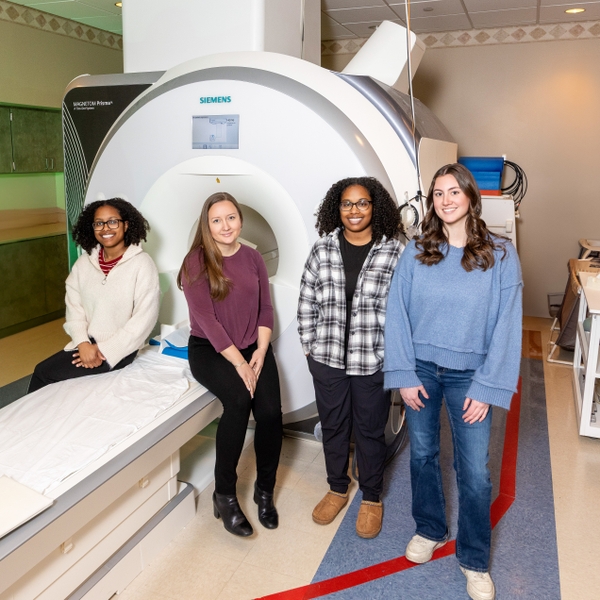
She also meets weekly with other site coordinators, a vital routine to maintain uniformity of the study across the country and keep the data set consistent. This information is made available as an open data set, meaning any researcher with a hypothesis about the adolescent brain can use the data to investigate.
David Dodell-Feder, PhD, associate professor of Psychology and Neuroscience at the University, is not part of the ABCD Study but he used the data to find that the more urban an environment a child lived in—proximity to roads, houses with lead paint risks, families in poverty, and income disparity—the greater number of psychotic-like experiences they had over a year’s time. These findings align with past research conducted in young adults but have not been found in pre-adolescence until the robust data set from the ABCD Study became available. It is information that could inform when future screening and intervention strategies should start.
The origin story of the study was narrower than where the data has led researchers. It was designed initially by Collaborative Research on Addiction at NIH (CRAN), a partnership between the National Institute on Alcohol Abuse and Alcoholism (NIAAA), the National Institute on Drug Abuse (NIDA), and the National Cancer Institute (NCI), to understand how substance use and other experiences during adolescence influence development. Answering these questions required a large-scale long-term study, and more partners were brought in to develop this study, including the Eunice Kennedy Shriver National Institute on Child Health and Human Development (NICHD), and the National Institute of Mental Health (NIMH), among others. Together, they established what is known today as the ABCD Consortium and began gathering data to allow the creation of baseline standards for brain development, similar to what currently exists for growth, like height and weight.
Working For and With the Community
It takes more than family buy-in to have a study like this be successful. Each study site has a designated Community Liaison Board that acts as a touchpoint for stakeholders within the community. In Rochester, Laurence Wahl, director of strategic planning & secondary English Language Arts at the Webster Central School District, is one of five board members.

“I wanted to be a touch point of this group because of how compelling the research was,” Wahl said. “How cool it was that we could see all of these things that you wondered about before functional MRIs, but they allow you to see what’s taking place in somebody’s brain and then the practical application of building a better environment for learning to happen in school. The thing that gets me so excited about this is the prospect of serving kids in our classrooms more effectively. We only have them a short amount of time, and I’m greedy for never wasting a minute with our kids.”
Wahl and his team are often looking for modifiable risk factors—things as a district they can respond to that will better the learning and life of their students. Regular updates about findings from the ABCD study help with this approach. “I think when you get into physical development like what the ABCD study is looking at, and it backs up where emotional behaviors are coming from, it gives more tools to more people to understand better why kids do the things that they do, which means we're better able to help them navigate through difficult moments.”

Research Impacts Learning
As the University began recruiting for the ABCD Study, the Webster Central School District was already making changes based on prior research around adolescence and sleep. In 2019, it became the first school district in Monroe County, New York, to swap the start times between its high schools and elementary schools. “In just the first semester, we saw attendance go up. We saw sports ineligibilities go down,” said Wahl. “And anecdotally, we saw teachers with many years of experience saying – this is remarkable, our kids are awake, and we can do things in the first period that we couldn't typically try to do in the first period.”
Originally appeared in NEUROSCIENCE | Volume 25
