

Student Spotlight: Yue Guzhang
Yue Guzhang is a fourth-year student in the Brain and Cognitive Sciences (BCS) Program at the University of Rochester. She received her undergraduate degree in BCS from the University. Guzhang works with Associate Professor Martina Poletti, PhD, in the Active Perception Lab, studying how attention and fixational eye movements influence our ability to see fine details in the fovea.
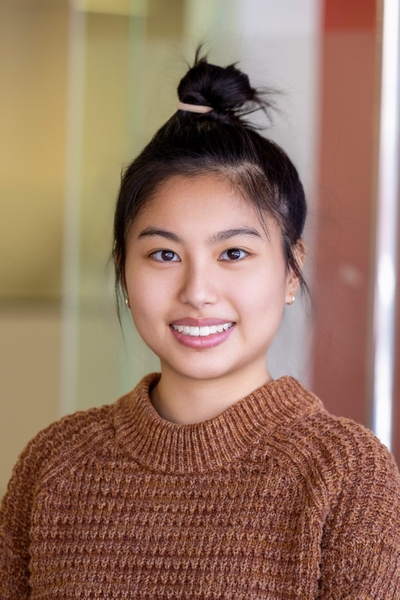
“The foveal region is a tiny but crucial part of the eye that we rely on to focus and see fine details up close,” said Guzhang. “Even though the foveal region takes up a large portion of the brain’s visual processing area, it hasn’t been studied as much as other parts of our visual field, mostly because it's technically challenging to precisely track where people are looking.”
Guzhang has first authored two papers. The most recent study, published in Current Biology, found that just before tiny eye movements, known as microsaccades, happen, the ability to see fine details improves in a small area around the upcoming eye movement target. At the same time, visual sharpness slightly decreases the point of fixation. Her previous research, also published in Current Biology, found that, exogenous attention, the process that helps us quickly process important visual information, can also briefly enhance our ability to see fine details at the attended spot within the fovea. However, this enhancement diminishes over long periods, and sensitivity increases in other parts of the fovea that were not the initial focus.
The University of Rochester felt like the right community in the right climate for Guzhang when she decided to attend for her undergraduate studies. Although initially undecided, she quickly chose BCS as her major after taking the Perception and Action course. “It was taught by Dr. [Duje] Tadin, and he spent a lot of time talking about visual perception, and it made me realize it is such a huge part of our life. Our eyes are always looking around, examining our surroundings. I realized there's so much inside the brain going on when we look out into the world, and I really wanted to know more about vision science and how we see things.”
Today, she is contributing to the intellectual foundation of the undergraduate program, which has served her well. In 2024, she received the Edward Peck Curtis Award for Excellence in Teaching from the Provost's office for co-developing and teaching an undergraduate programming course that teaches students how to use MATLAB—a programming language often used in research labs. “I think it's almost like giving back to the BCS community. I received a lot of help from the grad students in the lab when I was an undergraduate research assistant, and now, I can pass on some of this knowledge to help students gain necessary research skills.”
Originally appeared in NEUROSCIENCE | Volume 25
