

Faculty Q&A: Sunday Francis, PhD
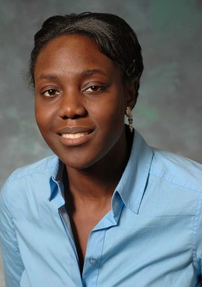
Sunday Francis, PhD, is an assistant professor of Neuroscience. She completed her PhD in Computational Neuroscience at the University of Chicago. And received her undergraduate degree in Neuroscience at Brown University. She researches transdiagnostic symptoms (TMS), like compulsivity, of neurodevelopmental disorders (NDD), aiming to impact individuals regardless of their diagnosis. Her lab uses transcranial magnetic stimulation, or TMS, to understand how stimulation to the brain can impact these symptoms.
Please summarize your research.
My lab studies pediatric neuromodulation and NDD. We use TMS, a non-invasive form of brain stimulation that uses magnetic pulses to induce electrical fields in the brain through the scalp. We ‘ping’ a system, either exciting or inhibiting the network, and then note how it changes. Unlike deep brain stimulation, TMS is non-invasive and can be used as a treatment for depression and OCD, and it has just been FDA cleared for adolescent depression.
How did you become interested in your field?
I do not like to be bored, and science does not let me get bored. If you can keep me interested, I can pretty much tune out the whole world. I initially went to school for engineering and loved it, but loved my Neuroscience department more, so I transferred. My graduate work was in brain–machine interface development, investigating technology that could aid individuals who suffered a stroke or had amputations. Then, during my postdoc, I would end up taking a systems neuroscience approach to genetic and molecular research in NDD, specifically autism spectrum disorder, connecting it to my graduate work via repetitive behaviors and the impact on motor skills. I also learned techniques in pediatric neuromodulation in children and adolescents with perinatal stroke and Tourette’s, respectively. I then went on to the National Institutes of Health as a research fellow, developing new projects and skills in pediatric neuromodulation, which is at the center of my research today.
What brought you to the University of Rochester?
I was aware of the University, given that my mother started her PhD in education there during my graduate years. Later, I would meet Nathan Smith, PhD, through a professional development group. He introduced me to Ben Suarez-Jimenez, PhD, John Foxe, PhD, and M. Kerry O’Banion, MD, PhD, who won me over when he shared that he had grants from NASA. Eventually, I was selected as a speaker for the Del Monte Institute’s postdoctoral speaking series called NEUROYES.
I have always worried about finding a place that would appreciate my diverse scientific background, many different interests, and my use of varied tools to answer questions. URochester seemed to embrace that; they were not scared by it. I got the feeling they were open to someone who wants to bring different expertise and viewpoints together to answer really cool questions. That seemed unique.
What is your favorite piece of advice?
I guess the best piece of advice anyone has ever told me is just: “Do what you enjoy, do what you love.”
Originally published in NEUROSCIENCE Volume 27.
